Treasury cyberattack: what we know about the FinCEN breach
FinCEN, the Treasury bureau that receives banks' suspicious-activity reports, says an intruder reached part of its systems. What is known, and what isn't.
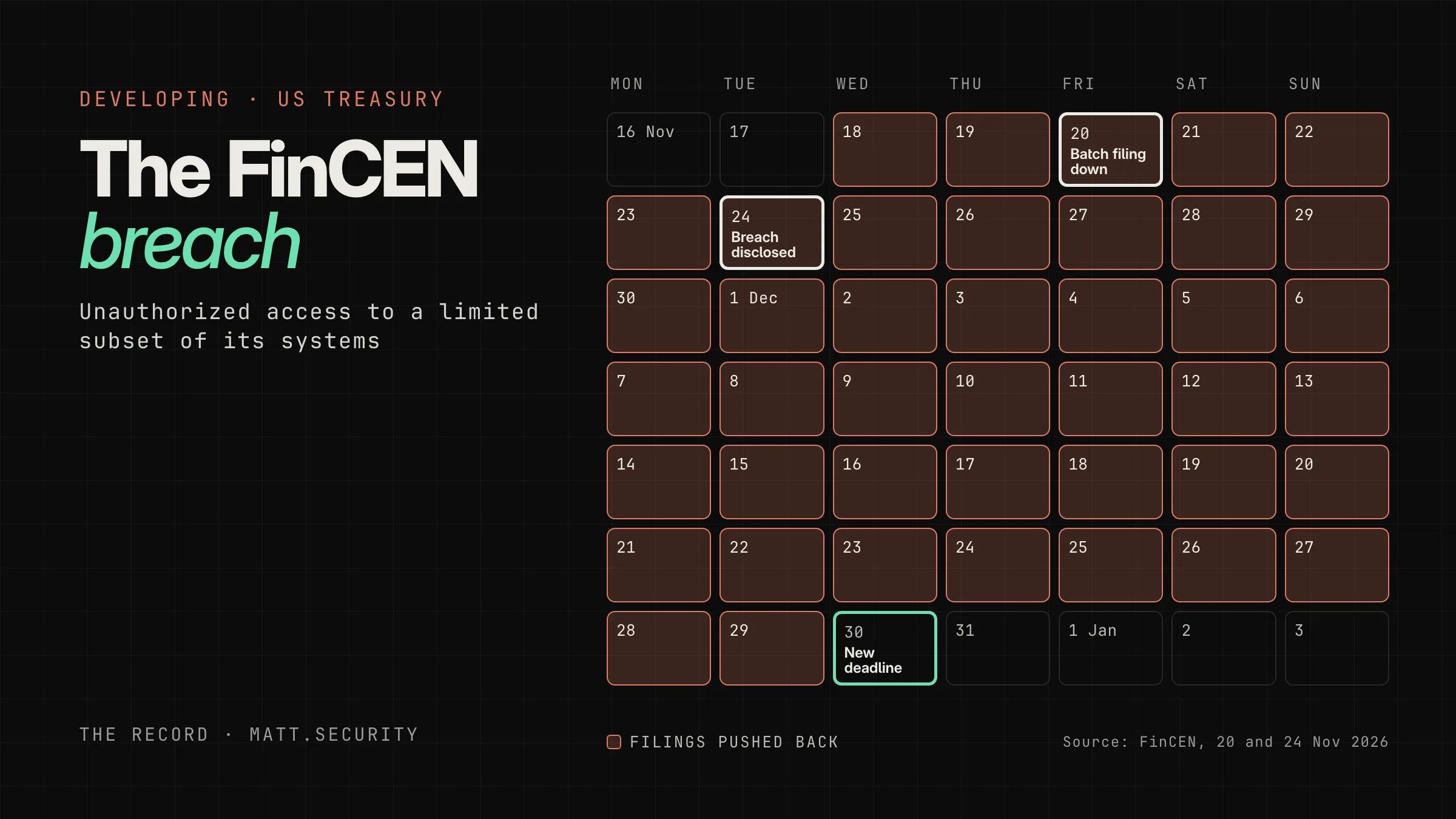
On 24 November 2026 the Financial Crimes Enforcement Network (FinCEN), the US Treasury bureau that receives the suspicious-activity reports banks file, said it is investigating a cybersecurity incident that gave someone unauthorised access to "a limited subset of its systems", and that it has taken some systems offline. The same day it moved filing deadlines for reports due from 18 November, six days before the disclosure, to 30 December (FinCEN ↗, FinCEN order ↗). It has not said who got in, how, when, or what they reached.
This is a developing story, last updated 25 November 2026, 04:15 UTC. We are following it through the week and will add what FinCEN, the Treasury and investigators publish; every change is listed under Updates at the end, with its date.
ExploitOps WeeklyStories like this one, by email every Friday.Subscribe
FinCEN's notice came hours after The New York Times reported a breach of an unclassified intelligence system used by the CIA and the Office of the Director of National Intelligence, in which the Times' sources said the intruders apparently used Artex, the AI hacking tool the FBI warned about on 13 November. No official has linked the two incidents. They land in a month in which the FBI is investigating an apparent hack of its national crime database and the Agriculture Department took payment systems offline after a security incident, alongside a run of outages that officials say were caused by upgrades and patching.
What FinCEN has said
FinCEN's account so far is one alert on its BSA E-Filing site, the portal banks and other institutions use to file Bank Secrecy Act reports, and one order on deadlines. The alert says (FinCEN ↗):
- →FinCEN is investigating a cybersecurity incident that "resulted in unauthorized access to a limited subset of its systems".
- →As a proactive measure it has taken some systems offline. The BSA E-Filing website remains operational, but some services may be temporarily unavailable.
- →It is extending deadlines for filers affected by the disruption and working to return all systems to normal.
- →An institution that needs to get suspicious-activity information to law enforcement quickly can use the Financial Institutions Hotline, 1-866-556-3974, which the disruption has not affected.
It has not said which systems were reached, when the intrusion began or was found, how the intruder got in, whether any reports or records were read or copied, or who is responsible. As of this update the Treasury has published no statement of its own.
What the deadline order shows
The order, FIN-2026-R002, never uses the word cyber. It grants "temporary, limited exceptive relief" for "a service disruption that is hindering filers' ability" to meet their reporting obligations, and FinCEN may change or extend it (FinCEN order ↗). It covers two groups:
| Who | Reports covered | Due between | New deadline |
|---|---|---|---|
| Financial institutions that used Secure Data Transfer Mode (SDTM) as of 18 November | Bank Secrecy Act reports, including suspicious-activity and currency transaction reports | 18 November and 29 December | 30 December 2026 |
| Companies and individuals under the beneficial ownership rule | Beneficial ownership information reports and FinCEN ID updates | 18 November and 29 December | 30 December 2026 |
SDTM is FinCEN's server-to-server channel for institutions that send their reports in batches; FinCEN's own documents call it Secure Direct Transfer Mode (FinCEN ↗). It was the first part to fail in public. On 20 November, four days before the word cyber appeared, the BSA E-Filing site reported "a service disruption impacting Secure Direct Transfer Mode (SDTM) batch filers only" and said the website remained fully operational (Fox News ↗). By 24 November the same alert described a cybersecurity incident, and some services on the site itself were unavailable.
Two details stand out. The relief reaches back to 18 November, six days before FinCEN called it a cybersecurity incident. FinCEN has not said whether the SDTM disruption and the intrusion are the same event or when the intrusion began, but the order treats batch filers as affected from that date. And the relief is narrow: institutions must keep monitoring for suspicious transactions throughout, and urgent cases go to the hotline. The beneficial ownership part reaches fewer filers than it once would have: since March 2025 only companies formed abroad and registered to do business in a US state have to file those reports (FinCEN ↗).
When we checked at 04:00 UTC on 25 November, three other FinCEN addresses did not answer: the beneficial ownership filing site (boiefiling.fincen.gov), the sign-in portal for financial institutions (fiportal.fincen.gov) and the sign-in service behind it (iam.fincen.gov). Public web archives show the first two answering in October and November. FinCEN has not said which systems it took offline, and a site can be unreachable for other reasons.
Why FinCEN's systems matter
FinCEN is where the Bank Secrecy Act's reports end up. About 335,000 banks, casinos, money transmitters and other institutions file with it. In its 2025 fiscal year it received 4.8 million suspicious-activity reports and 21.5 million currency transaction reports, and 464 federal, state and local agencies ran more than 2.52 million searches of the data through its BSA Search tool (FinCEN ↗).
A suspicious-activity report names a customer an institution suspects of a crime, and federal law forbids the institution to reveal that a report was filed, including to the customer (31 U.S.C. 5318(g)(2) ↗). The searches matter too: a record of what investigators looked up shows who they are looking at.
That is why the scope matters more than the outage. A filing channel that is down for a few weeks is an inconvenience that an order can cover. Reports that were read would be a different matter, and FinCEN has not said either way.
The same day: the CIA, ODNI and NGA
On 24 November The New York Times reported that the CIA and ODNI had found a breach of an unclassified system used for open-source intelligence analysis: the work of reading public and commercially bought material, from news and social media to satellite imagery. Nextgov/FCW, citing the Times, said the National Geospatial-Intelligence Agency was affected at the same time (Nextgov/FCW ↗).
- →Officials: an ODNI official told CNN "There have been no disruptions to critical capabilities or classified systems." The CIA declined to comment (CNN ↗, CyberScoop ↗).
- →Status: a person familiar with the incident told the Associated Press that the issue has been resolved; CNN said it was not clear when the hack happened (AP ↗, CNN ↗).
- →Who: two sources told CNN that early indications suggest the hack may have originated in China, though it was not clear whether the Chinese government was involved. No official has attributed it (CNN ↗).
- →How: the Times' sources pointed to Artex as the tool used, Gizmodo and Nextgov/FCW reported. Nextgov/FCW also reported, from two people, that Artex was used in a separate intrusion into the Defense Department's Cyber Defense Command, which one of them called low-impact (Gizmodo ↗, Nextgov/FCW ↗).
Artex is an open-source framework that hands a language model the work of planning and running an intrusion. The FBI's alert of 13 November says criminal and state-aligned groups have used it since at least August 2026, against financial services and government among other sectors, some going from first probe to privileged access in under three hours (FBI ↗). The alert names no US federal victim, and no outlet has reported that Artex was used against FinCEN. Our explainer on Artex covers what it is and what the FBI asked organisations to check.
An unclassified system can still be sensitive. The raw material in such a system is public or bought, Ben Bernstein of Huntress told CyberScoop; the value to an adversary lies in "seeing what the CIA and ODNI are doing with it" (CyberScoop ↗). The same holds for any system that records what investigators look up.
November's incidents and outages, in order
Several of these were outages that officials and companies say were caused by upgrades, bugs or patching. They are listed because they shaped how the intrusions were received; the right-hand column says what each was attributed to.
| Date | What happened | Attributed to | Source |
|---|---|---|---|
| 12–13 Nov | Global Microsoft 365 outage | A months-old bug from a July update, according to Microsoft | BleepingComputer ↗ |
| 13 Nov | FAA nationwide ground stop | A single router at a radio site in Arkansas | CNN ↗ |
| 13 Nov | FBI alert on Artex, the AI hacking tool | Criminal and state-aligned groups since August | FBI ↗ |
| 16 Nov | JPMorgan Chase online banking and Zelle delays | A software bug in on-premise hardware, which the bank said was unrelated to cyber activity | AP ↗ |
| 16–19 Nov | Agriculture Department takes farm payment applications offline and resets all database passwords | A security incident; intruder and data loss unknown | Nextgov/FCW ↗ |
| 17–20 Nov | NSA's classified internal network down for three days | Software patching, according to DNI Jay Clayton | Nextgov/FCW ↗ |
| 18 Nov | White House: "no indication of a cyberattack" behind the outages; FinCEN's filing relief window begins | Upgrades and patching, according to the DNI | White House ↗, FinCEN ↗ |
| 20 Nov | FinCEN reports a service disruption for SDTM batch filers | Not stated at the time | Fox News ↗ |
| 20–21 Nov | FBI investigating an apparent hack of the National Crime Information Center | Unknown | AP ↗ |
| 24 Nov | CIA and ODNI open-source intelligence system breached; NGA affected | Early indications point to China, two sources told CNN | CNN ↗ |
| 24 Nov | FinCEN discloses unauthorised access and extends deadlines | Unknown | FinCEN ↗ |
The same week the National Cyber Director, Sean Cairncross, left the White House; on 23 November DNI Jay Clayton became acting director and Kirsten Davies, the Pentagon's chief information officer, was named the intended nominee (CyberScoop ↗).
What is confirmed, reported and unknown
- →Confirmed by FinCEN: unauthorised access to a limited subset of its systems; some systems offline; deadlines for reports due 18 November to 29 December moved to 30 December; the hotline works.
- →Reported by anonymous sources: the use of Artex and a possible Chinese origin in the CIA and ODNI breach to the Times and CNN; the NGA's involvement.
- →Unknown: when FinCEN's intrusion began, how the intruder got in, what was reached, whether any reports were read or copied, who is behind it, and whether it is connected to the intelligence breach, the FBI database or the Agriculture Department incident.
Treasury's last breach, for comparison
The last breach the Treasury disclosed came through a vendor. On 8 December 2024 BeyondTrust told the department that an attacker had obtained a key used to secure its cloud remote-support service. With it, the attacker could override the service's security, remotely reach some workstations in the Treasury's Departmental Offices and open unclassified documents. The Treasury told Congress on 30 December, called it a major incident, attributed it to a China state-sponsored group and took the service offline (Treasury's letter, via TechTarget ↗).
Nothing published so far says the same route was used at FinCEN. The 2024 case shows the order the details came out in: the vendor's notice first, then the letter to Congress three weeks later with the attribution.
What to watch this week
- →A major-incident report. Federal law requires an agency to notify the relevant committees of Congress within seven days of having a reasonable basis to conclude that a major incident has occurred (44 U.S.C. 3554 ↗). In 2024 that letter was the Treasury's first detailed public account.
- →FinCEN's notices. Whether the alert on the BSA E-Filing site changes, when SDTM returns, and whether the order is extended past 30 December.
- →Attribution. Whether the FBI, CISA or the Treasury name an actor or a tool, and whether any official links FinCEN to the intelligence breach.
- →Congress. Whether the banking, homeland security or intelligence committees ask for a briefing.
For banks and other filers
- →Reports due between 18 November and 29 December that would have gone through SDTM can be filed by 30 December; keep a dated record of what was held and why (FinCEN order ↗).
- →Monitoring continues as normal. For suspicious activity that law enforcement needs quickly, the Financial Institutions Hotline is 1-866-556-3974.
- →Check any message about the incident, or about new filing routes, against fincen.gov and the BSA E-Filing site before acting on it.
- →Technical filing questions go to the BSA E-Filing Help Desk through its support form; questions about the order go to FinCEN's Regulatory Support Section (FinCEN order ↗).
Rules worth checking now
Whatever FinCEN's investigation finds, the month's incidents point to a few plain-English rules any team can check on its own systems, each of which holds or breaks on a given day:
- →Every report we owe a regulator has a second, tested route if the usual channel goes down.
- →Search and query logs are protected like the records they point to, because they show what we are looking at.
- →Every vendor and remote-access key into our network has an owner and an end date, and none outlives the work it was issued for.
MATT's ExploitOps Review tests rules like these against a company's own software with its team; the AI security audit guide explains how such reviews work.
Updates
- →25 November 2026, 04:15 UTC: first version, from FinCEN's alert and order of 24 November, and reporting on the CIA, ODNI and NGA breach.
Sources
- →FinCEN, BSA E-Filing service disruption alert ↗, 24 November 2026 (read 25 November).
- →FinCEN, Order FIN-2026-R002 ↗ and news release ↗, 24 November 2026.
- →FBI, FLASH alert on ARTEX ↗, 13 November 2026.
- →The White House, "No indication of a cyberattack" ↗, 18 November 2026.
- →CNN (via KQ2), CIA hit by hack impacting unclassified information ↗, 24 November 2026.
- →Nextgov/FCW, CIA, ODNI unclassified intelligence system hacked ↗, 24 November 2026; USDA grapples with security breach ↗, 19 November 2026.
- →CyberScoop, Unclassified intel system hit by hackers ↗, 24 November 2026; Davies and Clayton at the Office of the National Cyber Director ↗, 23 November 2026.
- →Associated Press, unclassified CIA system breached ↗, 24 November 2026; FBI investigating apparent hack of national criminal justice database ↗, 21 November 2026; JPMorgan Chase technical issue ↗, 16 November 2026.
- →Gizmodo, U.S. spying agencies reportedly hacked ↗, 24 November 2026.
- →BleepingComputer, Microsoft says months-old bug caused global Microsoft 365 outage ↗, 16 November 2026.
- →Fox News, Treasury's Financial Crimes Enforcement Network reports a 'service disruption' ↗, 20 November 2026.
- →FinCEN, SDTM batch filing requirements ↗; Year in Review FY2025 ↗, May 2026; beneficial ownership reporting ↗, updated 11 August 2026.
- →TechTarget, Treasury Department breached through BeyondTrust service ↗, 31 December 2024, quoting the Treasury's letter to the Senate Banking Committee.
- →United States Code, 44 U.S.C. 3554 ↗ (major incident notification) and 31 U.S.C. 5318 ↗ (suspicious-activity report confidentiality).
- →MATT's own connection checks of fincen.gov sites, 25 November 2026, 04:00 UTC, and Internet Archive captures of boiefiling.fincen.gov and fiportal.fincen.gov.
Questions
Was the US Treasury hacked?
FinCEN, a bureau of the Treasury, said on 24 November 2026 that a cybersecurity incident gave someone unauthorised access to a limited subset of its systems, and it took some systems offline. It has not said what was reached, and the Treasury has made no separate statement so far.
What is FinCEN and what data does it hold?
FinCEN is the Treasury bureau that collects and analyses reports under the Bank Secrecy Act. About 335,000 institutions file with it; in fiscal 2025 that was 4.8 million suspicious-activity reports and 21.5 million currency transaction reports, which 464 agencies can search.
Is the FinCEN breach connected to the CIA hack or to Artex?
No official has linked them. The Times' sources said the CIA and ODNI intruders apparently used Artex, an AI hacking tool, and no outlet has reported Artex in FinCEN's case.
Do banks still have to file suspicious activity reports?
Yes. Institutions that file through SDTM have until 30 December for reports due from 18 November to 29 December, must keep monitoring throughout, and can use the Financial Institutions Hotline, 1-866-556-3974, for urgent cases.
Who is behind the FinCEN breach?
FinCEN has not said, and no official or outlet has named an actor. Two sources told CNN the separate CIA and ODNI breach may have originated in China, without saying whether the Chinese government was involved.