Security audit procedures: a step‑by‑step checklist
Security audit procedures in order: seven steps, a twelve-area checklist, the evidence an auditor asks for, and the control each item maps to.
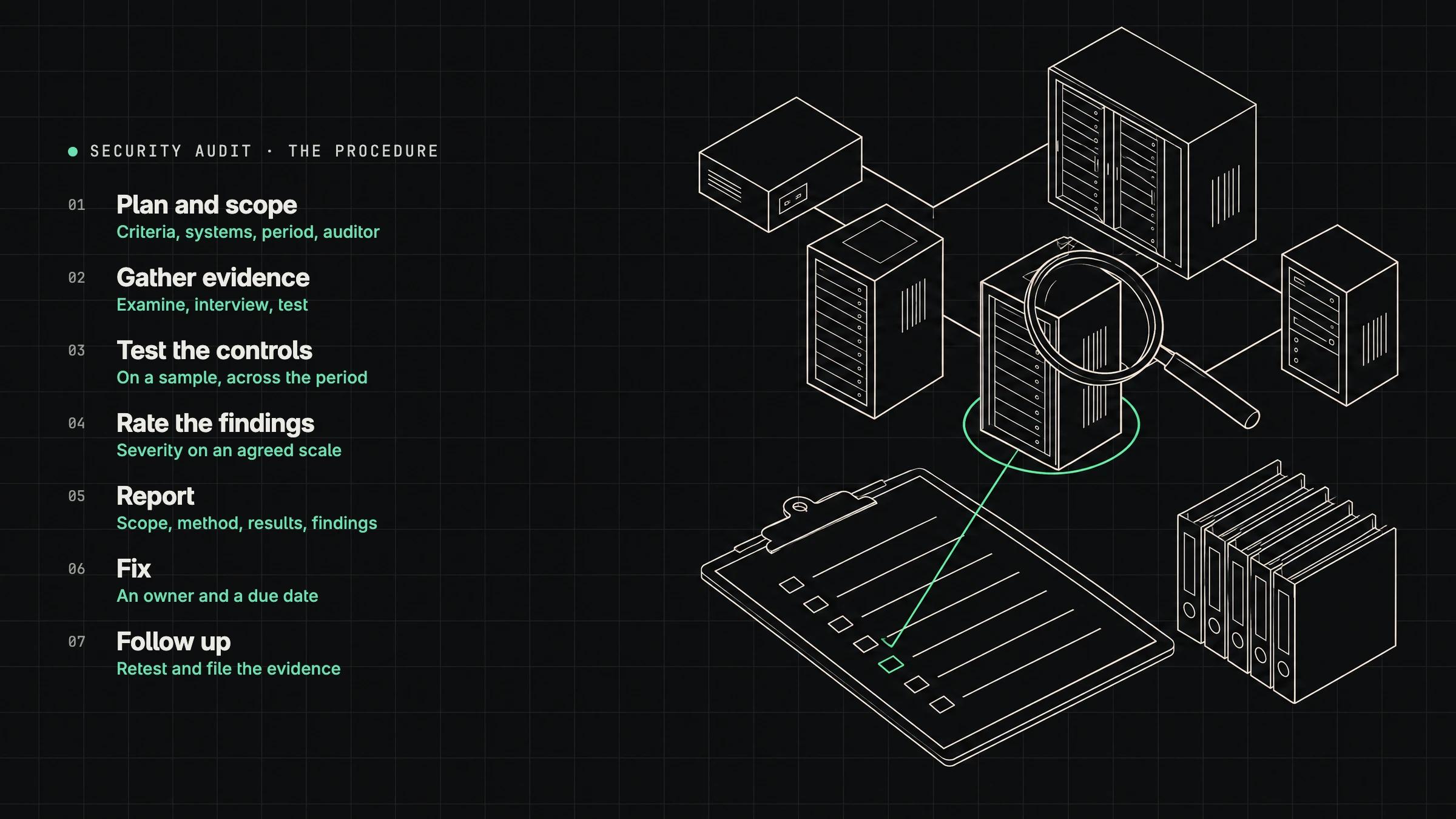
A security audit is a planned, independent check of your controls against written criteria, backed by evidence. The procedure has seven steps: plan and scope, gather evidence, test the controls, rate the findings, report, fix, and follow up. This guide walks through each step, then gives a twelve-area checklist with the evidence an auditor asks for and the control each item maps to.
It is written for a CTO, engineering lead, IT manager or security manager at a software company who has to run an audit, prepare for one, or buy one. Every definition, figure and control reference comes from the body that publishes it: NIST, CIS, the PCI Security Standards Council, the US Department of Health and Human Services, FIRST, AICPA and OWASP. The checklist works with any auditor and any framework.
ExploitOps WeeklyStories like this one, by email every Friday.Subscribe
What a security audit is, and what it is often confused with
NIST’s glossary defines an audit ↗ as a systematic, independent and documented process that obtains evidence and evaluates it objectively against audit criteria. Three words carry the weight. Criteria are the written standard you are measured against. Evidence is what shows a control exists and works. Independent means the person checking had no hand in the work being checked.
The same glossary sorts audits by who runs them. An internal audit is first party: the organisation runs it, or someone runs it on the organisation’s behalf. An external audit is second or third party, such as a customer or an independent audit firm. Information security audit and cyber security audit are two names for the same activity. Four neighbouring activities are often confused with it.
| Activity | What it does | What you get | Use it when |
|---|---|---|---|
| Security audit | Checks controls against written criteria, using evidence | A result for each criterion, and often a formal report or certificate | A customer, regulator or board needs independent assurance |
| Security assessment ↗ | An evidence-based evaluation and judgement. NIST’s glossary describes it as informational and separate from an audit | A view of strengths and gaps | You want to know where you stand ahead of an audit |
| Vulnerability assessment ↗ | A systematic examination that looks for deficiencies and judges whether security measures are adequate | A ranked list of weaknesses | You need regular coverage of known issues |
| Penetration test ↗ | Assessors, usually under set constraints, try to defeat a system’s security features | Proof of what can be exploited | You need to know what an attacker can reach |
| Risk assessment ↗ | A systematic examination of risk, so decision makers can prioritise | A ranked list of risks and a choice for each | You are deciding where to spend effort first |
An audit often uses the other four as evidence. If you are buying a penetration test for that purpose, the buyer’s guide to penetration testing services covers scope, reports and retests.
Which framework applies when
The framework supplies the criteria. Choose it by who is asking for the audit and what you sell. Each name below links to the publisher’s own page.
| Framework | Current version | Start here when |
|---|---|---|
| ISO/IEC 27001 ↗ | 2022 edition, with a 2024 amendment | You want a certifiable information security management system |
| NIST CSF 2.0 ↗ | February 2024. Six functions: Govern, Identify, Protect, Detect, Respond, Recover | You want a voluntary, outcome-based way to organise a programme and explain it to a board |
| NIST SP 800-53 Rev. 5 ↗ | Release 5.2.0, August 2025. 20 control families | You sell to US federal agencies, or you want the most detailed control catalogue |
| CIS Controls v8.1 ↗ | June 2024. 18 Controls and 153 Safeguards; Implementation Group 1 has 56 | You want a prioritised baseline with stated figures |
| SOC 2 ↗ | 2017 Trust Services Criteria with 2022 points of focus: security, availability, processing integrity, confidentiality, privacy | You are a service provider and customers ask for an auditor’s report |
| PCI DSS v4.0.1 ↗ | June 2024. 12 requirements | You store, process or transmit payment card data |
| CSA Cloud Controls Matrix v4.1 ↗ | January 2026 | You are a cloud provider answering customer security questionnaires |
| OWASP ASVS 5.0.0 ↗ | May 2025 | You need testable security requirements for a web application |
| Cyber Essentials ↗ | Requirements v3.3, in effect from 27 April 2026. Five controls, renewed every year ↗ | You sell in the UK and need a recognised baseline |
| HIPAA Security Rule ↗ | The HHS audit protocol, last updated July 2018 | You handle US health data |
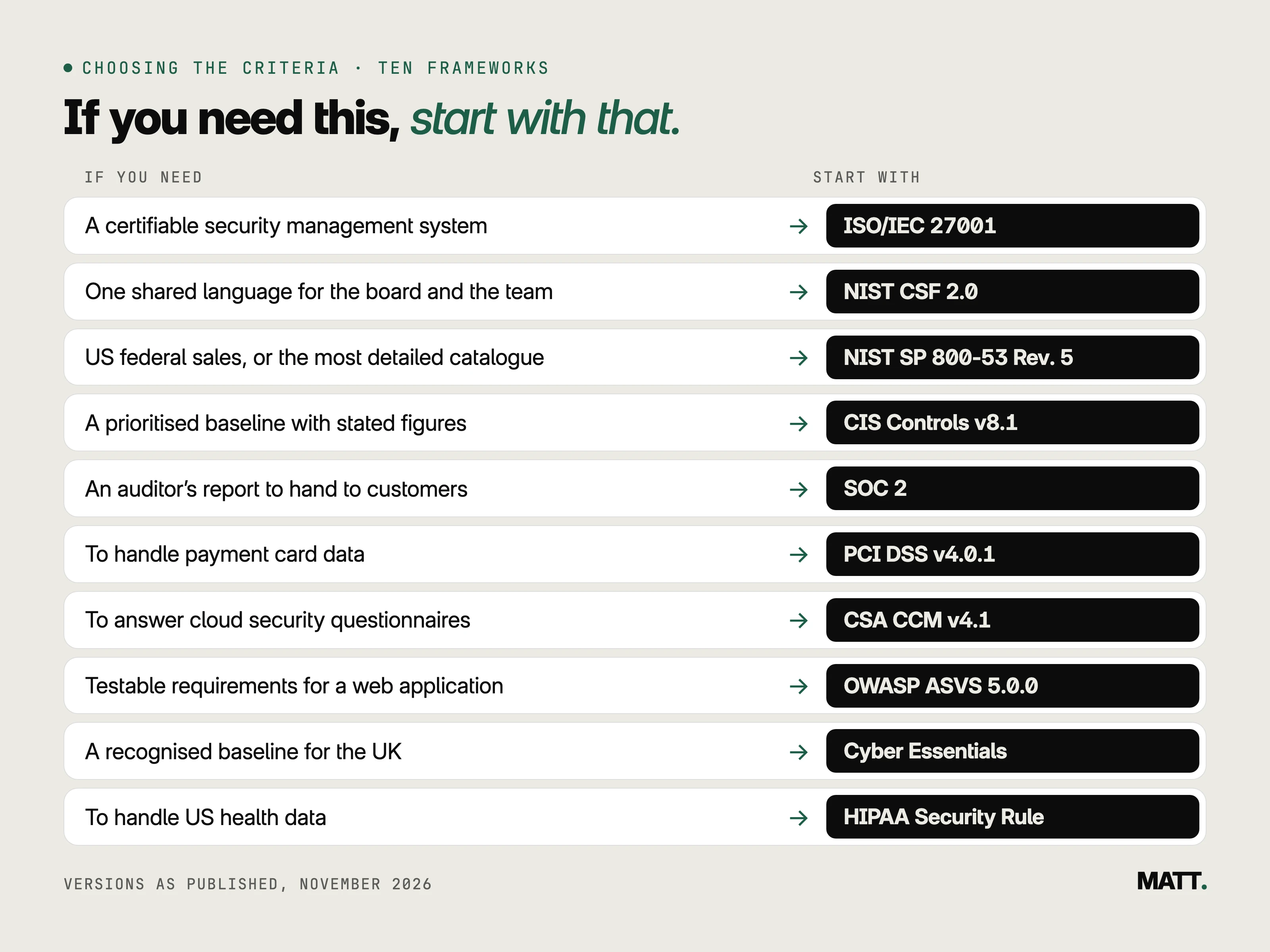
The frameworks overlap heavily, so evidence collected once usually serves more than one. For the conduct of the audit itself, the international reference is ISO 19011, the guideline for auditing management systems. Its 2018 edition has been withdrawn and replaced by ISO 19011:2026 ↗.
The audit in seven steps
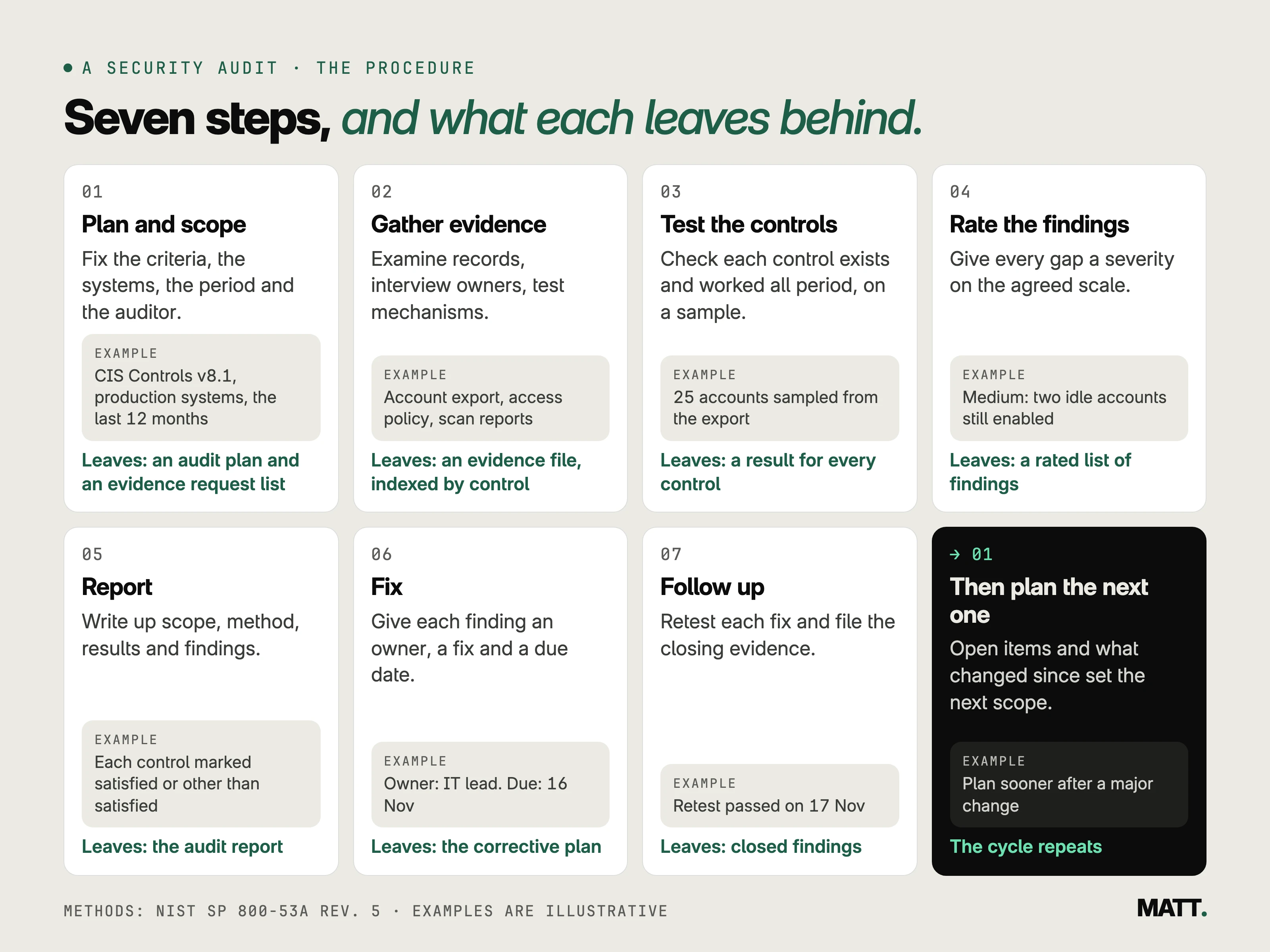
- →1. Plan and scope. Name the criteria, with the framework and its version. List the systems, teams and suppliers in scope, the period under review, and the auditor. Send the evidence request list early.
- →2. Gather evidence. The auditor collects documents, exports and records, and talks to the people who run each control.
- →3. Test the controls. Each control is checked twice: that it exists as written, and that it worked across the period. Testing is done on a sample.
- →4. Rate the findings. Every gap gets a severity on a scale agreed in step 1.
- →5. Report. The auditor writes up scope, method, results and findings.
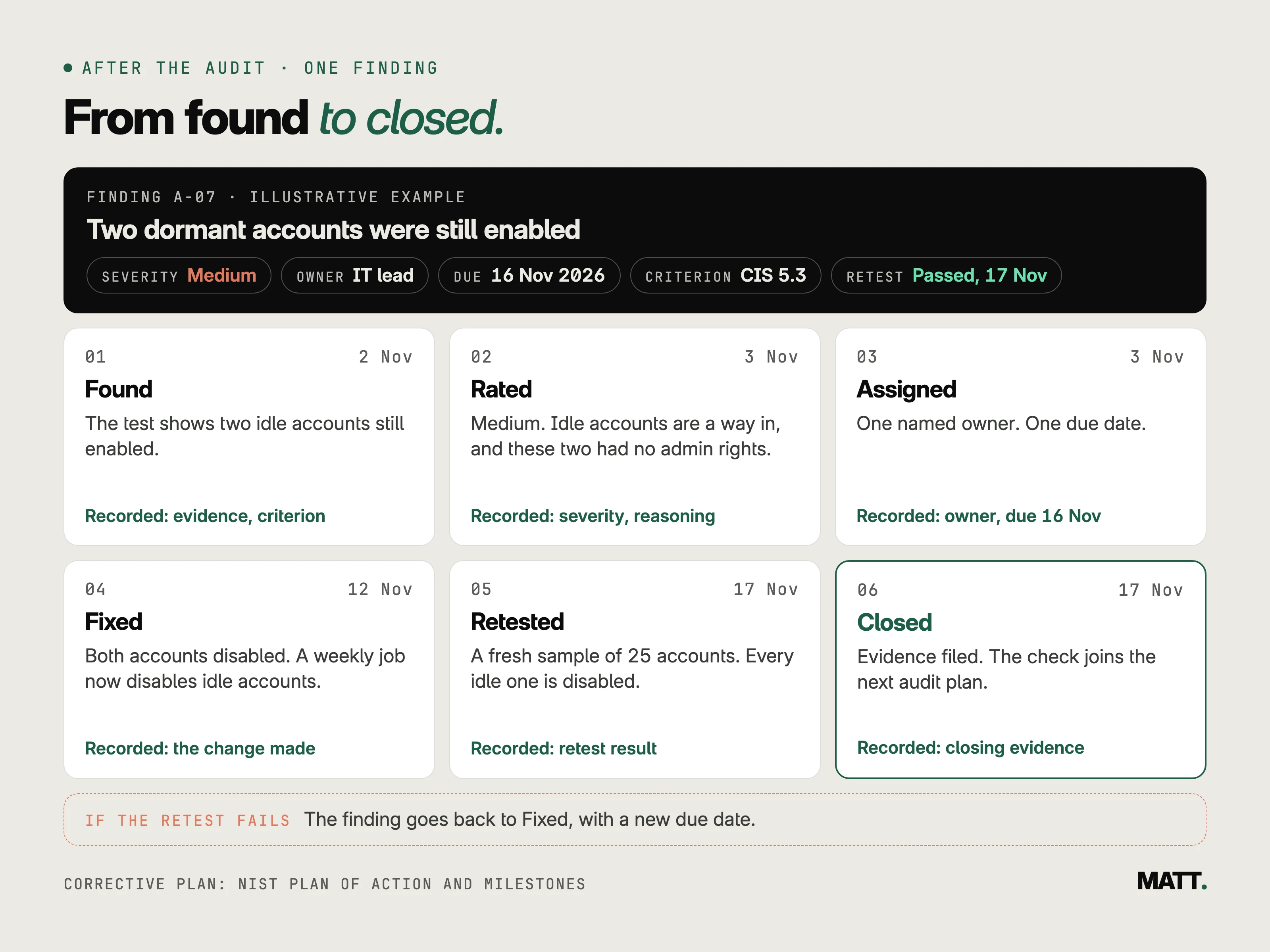
- →6. Fix. Each finding gets an owner, a fix and a due date in a corrective plan.
- →7. Follow up. Each fix is retested, the closing evidence is filed, and open items feed the next audit plan.
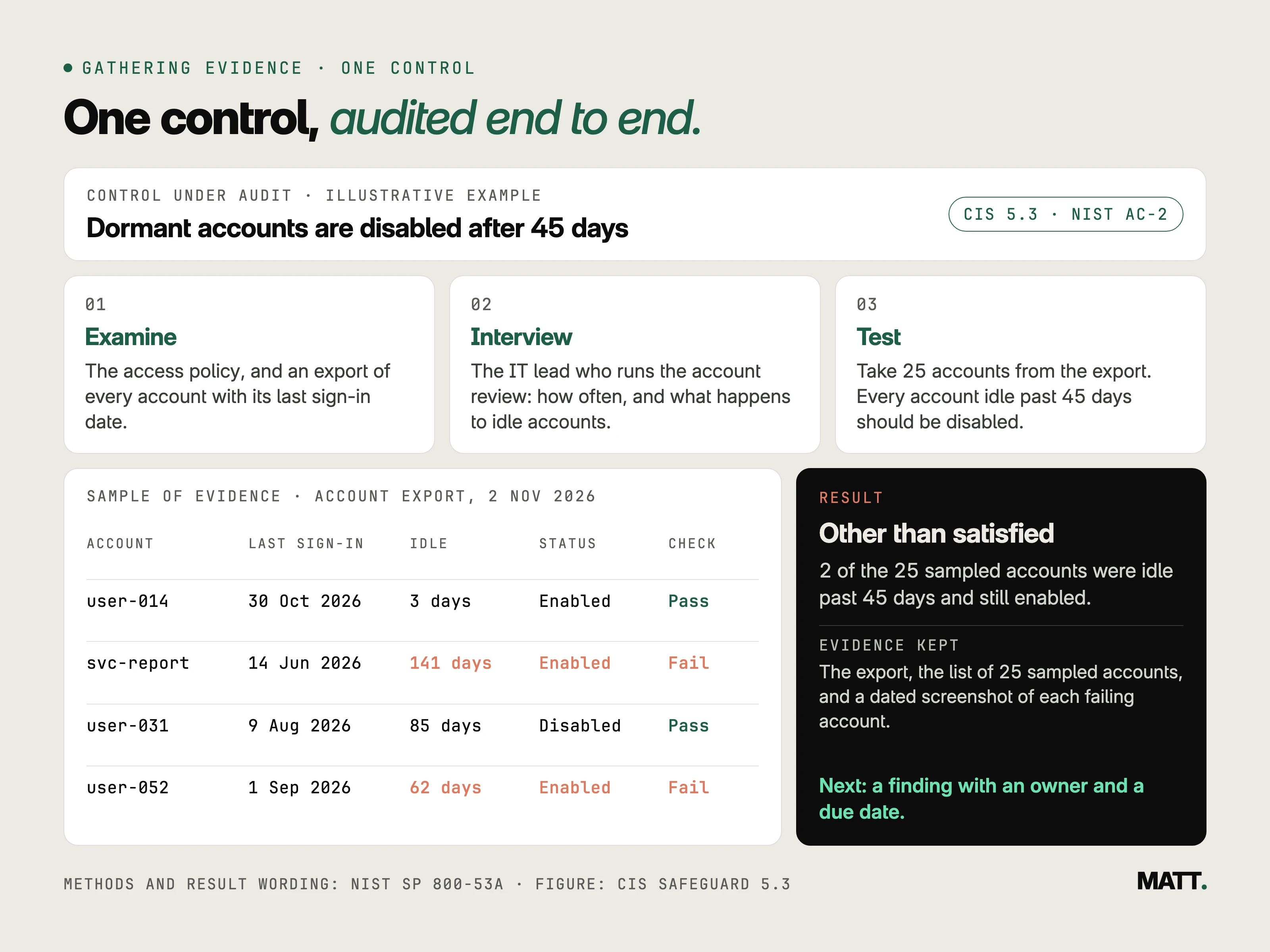
For step 2, NIST’s guide to assessing controls, SP 800-53A ↗, names three methods. They apply under any framework.
| Method | What it means | An example |
|---|---|---|
| Examine | Review, inspect, observe, study or analyse documents, mechanisms or activities | Reading the access policy; opening the scan results and patch records |
| Interview | Hold discussions with individuals or groups | Asking the person who approves access how a request is handled |
| Test | Exercise something under set conditions and compare what happens with what should happen | Signing in to an administrator console to confirm a second factor is required |
The first two columns paraphrase NIST. The examples are this guide’s. SP 800-53A also sets how hard the auditor looks. Depth and coverage each take one of three values: basic, focused or comprehensive. Coverage decides how many items are examined and how many people are interviewed. Agree both during planning, along with the sample sizes.
Expect sampling. The HHS audit protocol ↗ for HIPAA asks for a sample of items such as business associate agreements, and for instances from earlier periods when the requested number is unavailable. Keep dated records all year, and a sample request takes minutes to answer.
The checklist: twelve areas, the evidence, and the control references
Each row gives what the auditor examines, the evidence to have ready, and where the control sits in four published sources. The figures come from the CIS Controls assessment specification ↗ and the PCI DSS v4.0 self-assessment questionnaire ↗. In the last column, CIS means a CIS Safeguard, 800-53 means a NIST SP 800-53 control, and HIPAA means a section of 45 CFR in the HHS audit protocol ↗.
To use it today: mark each row green, amber or red. Green means the evidence exists and is current. Amber means it exists and is old or partial. Red means there is none. The red rows are your first findings.
Know what you have and who can reach it
| Area | The auditor examines | Evidence to have ready | References |
|---|---|---|---|
| 1. Asset inventory | A current inventory of devices and systems. CIS: reviewed twice a year, unauthorised assets dealt with weekly, active discovery run daily | Inventory export with an owner for each item; discovery tool output; the date of the last review | CIS 1.1–1.3; 800-53 CM-8 |
| 2. Identity and access | CIS: account inventory reviewed quarterly; dormant accounts disabled after 45 days; multi-factor sign-in for externally exposed applications, remote access and administrator access; access revoked when people leave. PCI: access reviewed every six months | A list of all accounts with owner and last sign-in; multi-factor settings export; leaver records matched to removal dates; signed access reviews | CIS 5.1, 5.3, 6.2–6.5; 800-53 AC-2, AC-6, IA-2, PS-4; PCI 7.2.4, 8.4.2; HIPAA 164.308(a)(3)(ii)(C) |
| 3. Configuration | CIS: a secure configuration process, reviewed yearly; automatic session lock after 15 minutes, two minutes on mobile devices; default accounts managed | Baseline documents; configuration scan results; exports of lock settings; a list of default accounts and their status | CIS 4.1, 4.3, 4.7; 800-53 CM-2, CM-6 |
| 4. Data protection | CIS: a data inventory, reviewed yearly; encryption on end-user devices, in transit and at rest. NIST adds key management | Data inventory with classification; encryption settings for disks, databases and storage; TLS configuration; key rotation records | CIS 3.2, 3.6, 3.10, 3.11; 800-53 SC-8, SC-12, SC-28; HIPAA 164.312(a)(2)(iv) |
Find weaknesses, keep records, recover
| Area | The auditor examines | Evidence to have ready | References |
|---|---|---|---|
| 5. Vulnerability and patch management | CIS: patching monthly; internal scans quarterly; external scans monthly. PCI: critical patches installed within one month of release | Scan reports for the whole period; patch records; tickets showing when each finding was fixed; approved exceptions | CIS 7.3–7.7; 800-53 RA-5, SI-2; PCI 6.3.3 |
| 6. Logging | CIS: logs kept at least 90 days and reviewed weekly. PCI: logs kept 12 months, with three months immediately available | A list of log sources; retention settings; records of each review and what followed | CIS 8.10, 8.11; 800-53 AU-6, AU-11; PCI 10.5.1; HIPAA 164.308(a)(1)(ii)(D) |
| 7. Backup and recovery | CIS: automated backups at least weekly; an isolated copy of recovery data; recovery tested quarterly on a sample | Backup job logs; proof the isolated copy exists; restore test records with dates and results | CIS 11.2, 11.4, 11.5; 800-53 CP-4, CP-9; HIPAA 164.308(a)(7)(ii)(A) |
| 8. Incident response | CIS: a named incident handler and a backup; the process reviewed yearly; an exercise every year; a review after each incident | The plan; the contact list; the exercise report; post-incident reviews with their actions | CIS 17.1, 17.4, 17.7, 17.8; 800-53 IR-3, IR-4, IR-8; PCI 12.10; HIPAA 164.308(a)(6)(ii) |
Build, buy, train and prove
| Area | The auditor examines | Evidence to have ready | References |
|---|---|---|---|
| 9. Secure development | CIS: the development process reviewed yearly; third-party components inventoried and evaluated monthly; developers trained yearly; code-level security checks; application penetration testing; threat modelling | The process document; a component inventory; training records; pipeline scan results; threat models; test reports | CIS 16.1, 16.4, 16.9, 16.12–16.14; 800-53 SA-11, SA-15; NIST SSDF ↗ |
| 10. Third parties | CIS: an inventory of service providers, each classified, with security terms in contracts, reviewed yearly; each provider reassessed yearly | Provider list with the data each one holds; contracts; the latest assessment or audit report for each | CIS 15.1–15.5; 800-53 SA-9, SR-6; HIPAA 164.308(b)(1) |
| 11. Training | CIS: security awareness training at hire and every year. PCI: the awareness programme reviewed every 12 months | Completion records by person and date; the training content; role-based training for developers and administrators | CIS 14.1; 800-53 AT-2, AT-3; PCI 12.6; HIPAA 164.308(a)(5)(i) |
| 12. Penetration testing | CIS: an external penetration test at least once a year | The scope; the report; fix records; retest results | CIS 18.2; 800-53 CA-8; PCI 11.4 |
Three notes. The PCI patching figure changed between versions: v4.0 applied the one-month window to critical and high-severity patches, and v4.0.1 narrowed it ↗ to critical ones. The figures are the publishers’ own, and the auditor tests you against the criteria you adopted. Most frameworks also cover physical access (800-53 PE-2 and PE-3; HIPAA 164.310(a)(1)) and continuity planning (800-53 CP-2). For incident response in depth, NIST’s current guide is SP 800-61 Rev. 3 ↗, published in April 2025.
How findings are rated
A rating tells the owner how fast to act. Three published scales cover most audits, and each measures a different thing.
| Scale | Published by | Levels | Measures |
|---|---|---|---|
| CVSS v4.0 ↗ | FIRST | None 0.0; Low 0.1–3.9; Medium 4.0–6.9; High 7.0–8.9; Critical 9.0–10.0 | The severity of a technical vulnerability |
| SP 800-53A ↗ | NIST | Satisfied; other than satisfied | Whether a control meets its stated objective |
| SP 800-30 Rev. 1 ↗ | NIST | Very low; low; moderate; high; very high | The level of risk to the organisation |
Use them together. A control is marked other than satisfied, the weakness behind it gets a severity, and the risk level says what that means for your business. Whatever the scale, record six things for every finding: the criterion, what was found, the evidence, the severity, an owner and a due date. That list is this guide’s advice.
What the report and the corrective plan contain
Reports differ by framework, and the parts repeat. AICPA’s illustrative SOC 2 Type 2 report ↗ has four: management’s assertion, the description of the system, the service auditor’s report, and the tests of controls with their results. NIST’s SP 800-53A says an assessment report carries the assessor’s findings needed to judge how effective the controls are, and that the organisation may add a summary.
When you read a report, your own or a supplier’s, check five things. Which systems were in scope. Which period was covered. Which criteria and version were used. Which controls failed their tests. What management said it would do about each one.
The fixes go into a corrective plan. NIST calls it a plan of action and milestones ↗: a document that lists the tasks, the resources needed, the milestones and the scheduled completion dates. A workable plan has one row per finding, with these columns:
- →Finding and control reference: what was found, and against which criterion.
- →Severity: on the scale agreed during planning.
- →Owner: one named person.
- →Fix and resources: what will change, and what it needs.
- →Milestones and due date: dated steps for anything longer than a few weeks.
- →Retest date and result: who checked the fix, when, and what they saw.
- →Closing evidence: a link to the record that shows the control now works.
Free official tools to run it with
Each of these comes from a standards body, a government agency or an open-source project.
- →[CIS CSAT](https://www.cisecurity.org/controls/cis-controls-self-assessment-tool-cis-csat): a hosted self-assessment tool for tracking your progress against the CIS Controls. The hosted version is free for non-commercial use.
- →[CIS-CAT Lite](https://learn.cisecurity.org/cis-cat-lite): scores a system’s configuration against CIS Benchmarks.
- →[CISA CSET](https://github.com/cisagov/cset): the Cyber Security Evaluation Tool, built by CISA and Idaho National Laboratory.
- →[NIST CSF 2.0 quick-start guides](https://www.nist.gov/cyberframework/quick-start-guides): short guides for putting the framework to work, published as NIST SP 1299 to 1308.
- →[NIST SP 800-53A procedures](https://github.com/usnistgov/oscal-content): every assessment procedure in machine-readable form, with its examine, interview and test objects.
- →[OWASP ASVS 5.0.0](https://asvs.owasp.org/): the application requirements as a CSV file, ready to turn into a test plan.
- →[HHS Security Risk Assessment Tool](https://www.healthit.gov/topic/privacy-security-and-hipaa/security-risk-assessment-tool): version 3.7, as a Windows application and an Excel workbook, for HIPAA risk assessments.
- →[CSA CAIQ v4.1](https://cloudsecurityalliance.org/artifacts/cloud-controls-matrix-v4-1): the cloud security questionnaire used for STAR Level 1 self-assessment.
- →[OpenSCAP](https://www.open-scap.org/): open-source tools that check systems against SCAP security baselines.
- →[Prowler](https://github.com/prowler-cloud/prowler): an open-source cloud security tool under the Apache 2.0 licence.
Why audits matter: the data
Verizon’s 2026 Data Breach Investigations Report ↗ analysed more than 31,000 incidents and at least 22,000 confirmed breaches across 145 countries. Exploiting a vulnerability was the most common way in, at 31 percent of breaches. Credential abuse accounted for 13 percent. A third party was involved in 48 percent.
The same report looked at the vulnerabilities on CISA’s Known Exploited Vulnerabilities catalogue ↗, which held 1,795 entries on 24 November 2026. Organisations had fully fixed 26 percent of them, and the median time to do so was 43 days. IBM’s Cost of a Data Breach Report 2026 ↗ puts the global average cost of a breach at USD 4.99 million, up 12 percent, and IBM reports an average of 247 days ↗ to identify and contain one.
Each figure points at a row in the checklist: patching in row 5, access in row 2, suppliers in row 10. An audit is how you find out, with evidence, whether those rows are being done.
AI in scope
If your product has AI features, or your team ships AI-written code, add both to the scope. Four published references give you criteria.
- →[ISO/IEC 42001:2023](https://www.iso.org/standard/42001): requirements for an AI management system.
- →[NIST AI Risk Management Framework 1.0](https://www.nist.gov/itl/ai-risk-management-framework): published in January 2023 and now being revised. Its Generative AI Profile, NIST AI 600-1, followed in July 2024.
- →[OWASP Top 10 for LLM Applications 2025](https://genai.owasp.org/llm-top-10/): the ten main risks for applications built on language models. Prompt injection is first.
- →[OWASP Top 10 for Agentic Applications 2026](https://genai.owasp.org/resource/owasp-top-10-for-agentic-applications-for-2026/): published in December 2025, for systems where AI agents take actions.
Regulation is arriving too. The EU AI Act ↗ became generally applicable on 2 August 2026, with later dates for high-risk systems. In practice, add four items to your evidence list: an inventory of models, AI features and agents; the data each one can read; the actions each agent can take; and test results for prompt injection. Our explainer on what an AI security audit is goes further.
Common mistakes
- →Scoping by convenience. The system that holds customer data is left out because it is hard to audit.
- →Collecting evidence at the last minute. Undated screenshots prove little. Dated exports and tickets prove a control ran all year.
- →A policy with no proof of operation. The document says quarterly reviews. The auditor asks for the four review records.
- →Sampling the easy period. Agree the period and the sample in the plan, and let the auditor choose the items.
- →Findings with no owner or date. A finding owned by a team stays open.
- →Closing without a retest. A fix that nobody checked is a claim.
- →Marking your own work. The person who built a control should have someone else audit it.
- →Treating the certificate as the goal. An audit covers a sample over a period. Software changes every day after it.
Where an attacker’s‑eye test fits
An audit asks whether your controls exist and operate. An attacker asks a different question: is there one path through? Both questions need an answer. Row 12 of the checklist is where the second one sits, and a penetration test is the usual way to answer it. A test covers a chosen target on chosen days, and the product keeps changing afterwards.
One option for this part is MATT. It tests a product the way a modern, AI-assisted attacker does, writes each finding as a plain-English rule with a check, and re-proves the rules on every release, so each rule is reported as holding or broken. The audit page describes how it runs, and the attack catalogue lists the patterns it draws on. It sits beside a framework audit and a penetration test, and replaces neither.
Sources
- →NIST glossary: audit ↗ and plan of action and milestones ↗
- →NIST: SP 800-53A Rev. 5 ↗; SP 800-53 Rev. 5 ↗; SP 800-30 Rev. 1 ↗; CSF 2.0 ↗; SP 800-61 Rev. 3 ↗; SSDF ↗; AI RMF ↗
- →CIS: Controls v8.1 ↗; Controls assessment specification ↗
- →PCI Security Standards Council: PCI DSS v4.0.1 announcement ↗; v4.0 self-assessment questionnaire D ↗
- →US Department of Health and Human Services: HIPAA audit protocol ↗
- →AICPA: Trust Services Criteria ↗; illustrative SOC 2 report ↗
- →ISO: ISO/IEC 27001 ↗; ISO 19011 ↗; ISO/IEC 42001 ↗
- →FIRST: CVSS v4.0 specification ↗
- →Cloud Security Alliance: Cloud Controls Matrix v4.1 ↗
- →OWASP: ASVS 5.0.0 ↗; Top 10 for LLM Applications 2025 ↗; Top 10 for Agentic Applications 2026 ↗
- →UK NCSC: Cyber Essentials resources ↗
- →CISA: Known Exploited Vulnerabilities data ↗
- →Verizon: 2026 Data Breach Investigations Report ↗ and its executive summary ↗
- →IBM: Cost of a Data Breach Report 2026 ↗
- →European Commission: the AI Act ↗
Questions
What are security audit procedures?
They are the ordered steps of an audit: plan and scope, gather evidence, test the controls, rate the findings, report, fix, and follow up. NIST SP 800-53A names three ways to gather evidence: examine documents and systems, interview the people who run them, and test that controls behave as expected.
What should a security audit checklist include?
Twelve areas cover most frameworks: asset inventory, identity and access, configuration, data protection, vulnerability and patch management, logging, backup and recovery, incident response, secure development, third parties, training, and penetration testing. For each, list the evidence and the control it maps to.
What is the difference between a security audit and a penetration test?
An audit checks controls against written criteria, using evidence. A penetration test has assessors try to defeat a system’s security features, to show what an attacker could reach. The test is one piece of evidence an audit can use, and it answers a question the audit leaves open.
How often should an information security audit be done?
It depends on the framework. Cyber Essentials certification is renewed every year. The CIS Controls set yearly reviews for most processes, a yearly external penetration test and a yearly incident response exercise. Many companies run an internal audit once a year and again after a major change.
What evidence does an auditor ask for in a cyber security audit?
Dated records that show each control ran across the period: account lists with last sign-in dates, access reviews, scan and patch reports, log retention settings, restore test results, incident exercise reports, supplier assessments and training records. A policy alone shows intent; the records show operation.
Which framework should a software company start with?
Start from who is asking. Customers who want an auditor’s report usually name SOC 2 or ISO/IEC 27001. Card data means PCI DSS. US health data means HIPAA. If nobody has asked yet, the CIS Controls give a prioritised baseline with stated figures, and Implementation Group 1 has 56 Safeguards.