Penetration testing services: a buyer’s guide
How to buy penetration testing services well: what a test is, how to scope one, what a good report contains, and twelve questions to ask any provider.
A penetration test is a set period in which skilled testers attack your system the way an outsider would, with your written permission, and report what worked. Buying one well comes down to four things: a clear scope, named testers, a report you can act on, and a retest. This guide covers each, for any provider.
It is written for a CTO, founder or security lead who is buying a test, perhaps for the first time or because a customer, an auditor or a card scheme has asked for one. Every definition and requirement below comes from the body that wrote it: NIST, the UK’s NCSC, the PCI Security Standards Council, OWASP and CREST. Where the advice is MATT’s own, it says so.
ExploitOps WeeklyStories like this one, by email every Friday.Subscribe
What a penetration test is, and what it is often confused with
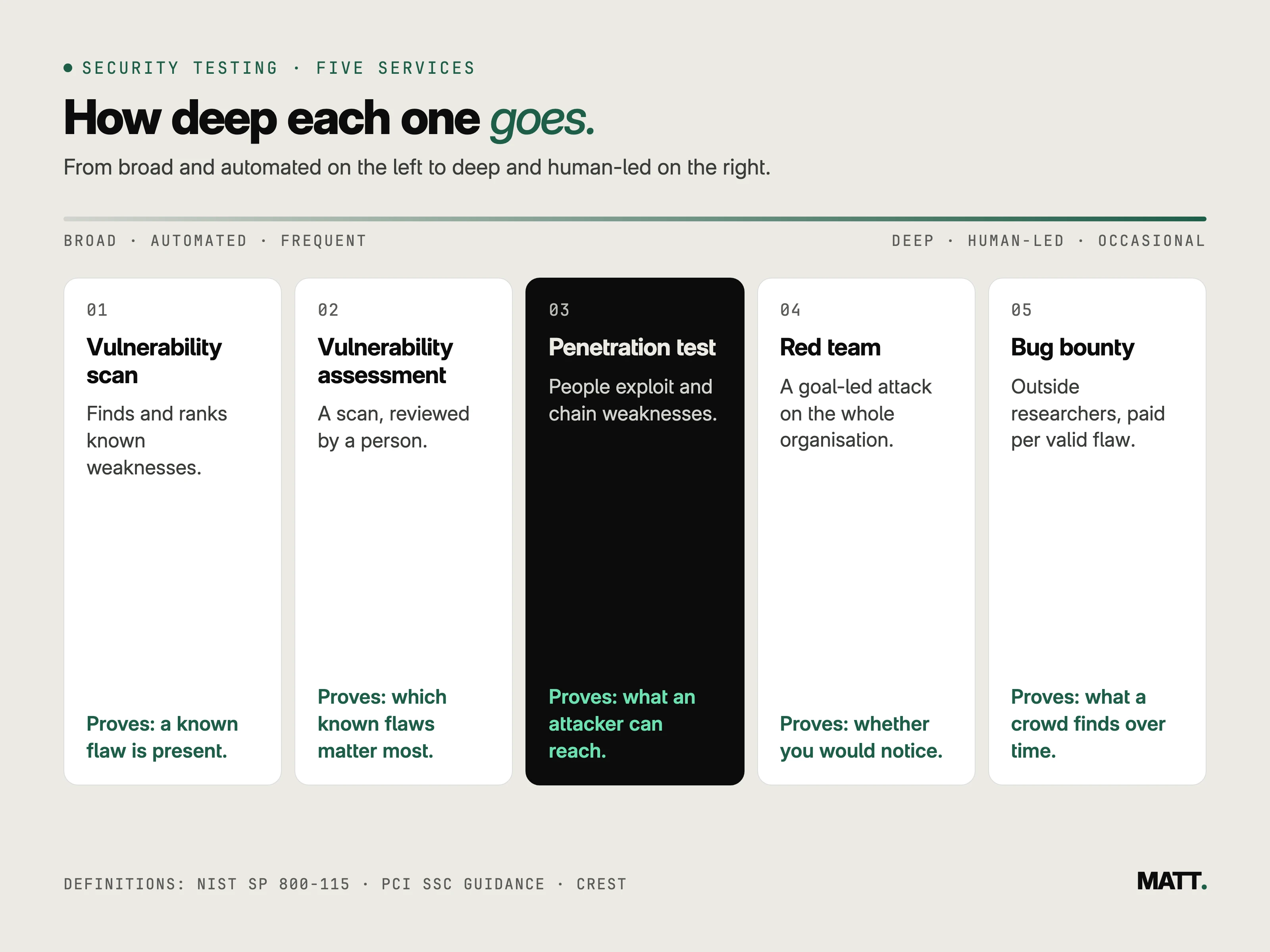
NIST’s technical guide to security testing ↗ describes penetration testing as testers mimicking real attacks to get around a system’s security features, often by chaining several flaws together. The NCSC calls it a way to gain assurance ↗ by trying to breach a system with an adversary’s tools and techniques. Four other services sit close to it, and quotes for them can look alike.
| Service | What it does | Mostly done by | Buy it when |
|---|---|---|---|
| Vulnerability scan | Finds, ranks and reports known weaknesses | Automated tools | You want frequent, broad coverage between tests |
| Vulnerability assessment | Scans, then a person reviews the results. Nothing is exploited | Tools plus an analyst | You need a list of known issues and their priority |
| Penetration test | People exploit weaknesses to show what an attacker could reach | Skilled testers, by hand | You need proof of what is exploitable in a defined system |
| Red team exercise | A goal-led attack on the whole organisation, people and buildings included | A specialist team, quietly | You already test regularly and want to test detection and response |
| Bug bounty | Outside researchers are paid for each valid flaw they report | A changing crowd | You want continuous outside attention on a mature product |
The PCI Council’s penetration testing guidance ↗ draws the line this way: a scan identifies and reports, and is mostly automated; a penetration test is manual and exploits what it finds. If a quote describes a tool run and a generated report, it is a scan. That is a useful service at a different price, and it will leave an auditor asking for the test.
The kinds of penetration test
A test is named after its target. Each target has a public reference that says what a thorough test covers, and a good provider will tell you which one it follows.
| Target | What testers look at | Public reference |
|---|---|---|
| Web application | Authentication, authorisation, sessions, input handling, business logic and more, across twelve categories | OWASP Web Security Testing Guide ↗, v4.2 |
| API | Object-level and function-level authorisation, authentication, resource limits, and seven more risks | OWASP API Security Top 10 ↗, 2023 |
| Mobile app | Storage, cryptography, authentication, network traffic and platform use on Android and iOS | OWASP Mobile Application Security Testing Guide ↗ |
| External network | What can be reached and used from the internet | NIST SP 800-115 ↗ |
| Internal network | What an attacker can do once inside, as a trusted insider or after getting past the perimeter | NIST SP 800-115 ↗ |
| Cloud service | Paths between tenants, from a tenant to the management layer, and from outside in | FedRAMP Penetration Test Guidance ↗, v3.0 |
| People and premises | Phishing, phone pretexts and physical entry. Always a separate, explicit part of the scope | NIST SP 800-115 ↗, section 5.3 |
A second choice is how much the testers are told. In a black-box test they start with nothing but a name. In a grey-box test they get accounts and some documentation. In a white-box test they get source code and architecture too. The PCI guidance notes that its tests are typically grey or white box, and that black-box testing can take more time and money for the same depth. For a software product, grey box with at least two accounts per role is the usual best value: the testers spend their days on your logic, with less time lost to guessing.
How an engagement runs, and what you do at each step
NIST describes four phases: planning, discovery, attack and reporting, with attack looping back into discovery as testers learn more. The Penetration Testing Execution Standard ↗ splits the same work into seven sections. From the buyer’s side there are six steps.
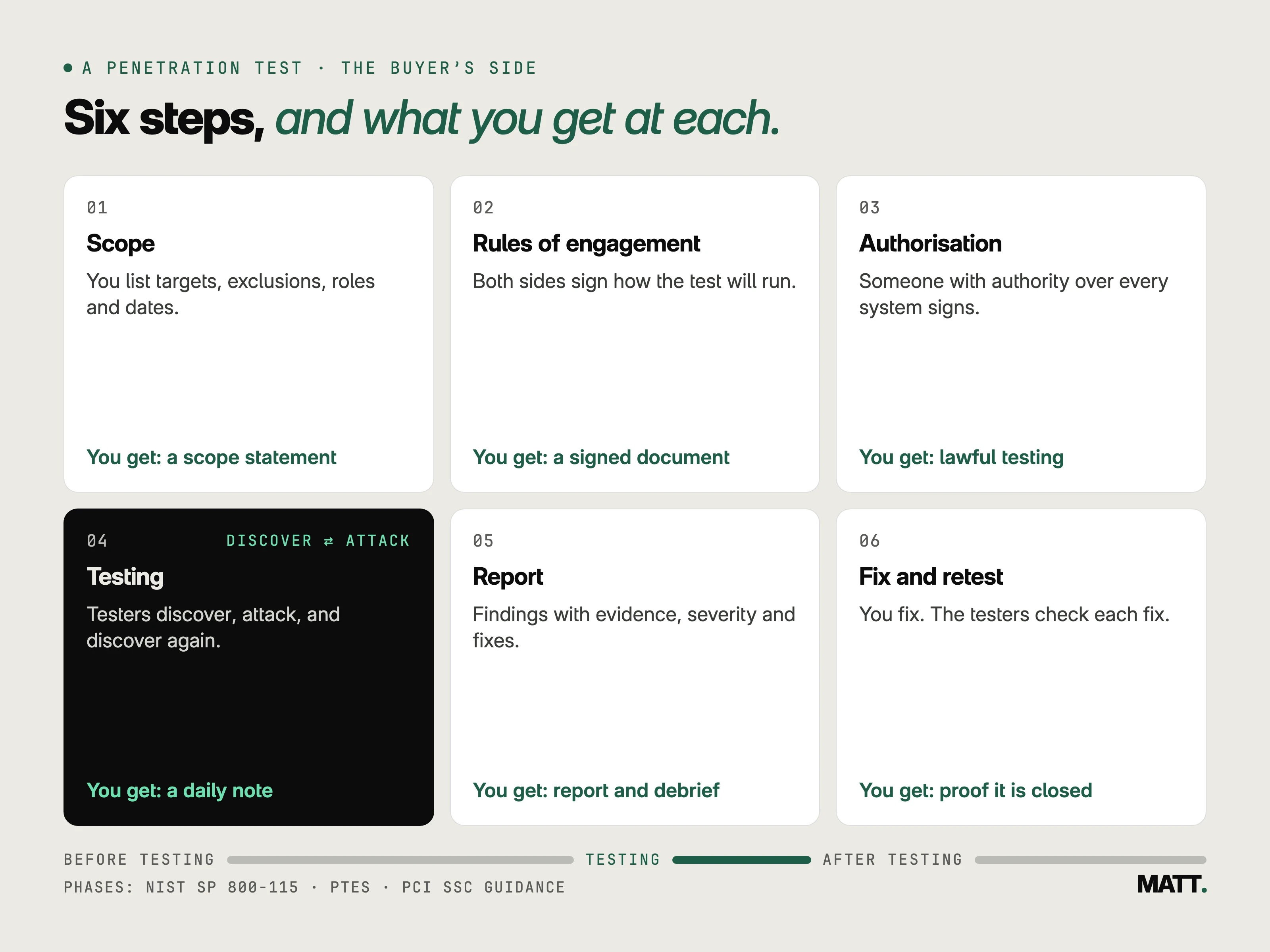
- →1. Scope. You agree what is in, what is out, and what is off limits. Most disappointing tests were scoped badly. The worksheet in the next section covers it.
- →2. Rules of engagement. A short document both sides sign. NIST’s template lists what it holds: purpose and scope, assumptions and risks, the schedule, who is on the team, a list of systems to exclude, how incidents are handled, and how data is treated.
- →3. Written authorisation. Testing a system without permission is an offence under the US Computer Fraud and Abuse Act ↗ and the UK Computer Misuse Act ↗. The signed permission is what makes the work lawful, so it must come from someone with authority over every system in scope.
- →4. Testing. Usually days to a few weeks. Ask for a short daily note, and agree in advance that anything critical is reported the same day, by phone.
- →5. Report and debrief. A written report and a call to walk through it with the people who will fix things.
- →6. Fix and retest. You fix; the testers check each fix. The PCI guidance expects exploitable findings to be corrected and retested, and warns that a long delay can mean a new test.
Two points on authorisation deserve care. First, your cloud provider has rules. AWS ↗ allows testing of listed services with no prior approval and prohibits denial-of-service tests. Microsoft Azure ↗ has needed no pre-approval since 2017 and asks testers to follow its rules of engagement. Google Cloud ↗ asks only that tests stay within your own projects and its terms.
Second, be exact about who can give permission. In September 2019 two testers hired to assess Iowa’s courts were arrested inside a county courthouse. The state’s court administration said ↗ it and the testing firm had read the scope differently. An independent review ↗ found an ambiguous agreement that had no legal review, and doubt over whether the client had authority over county buildings at all. Its advice applies to every test: list the permitted and prohibited techniques explicitly, and treat physical testing as its own category.
A scoping worksheet
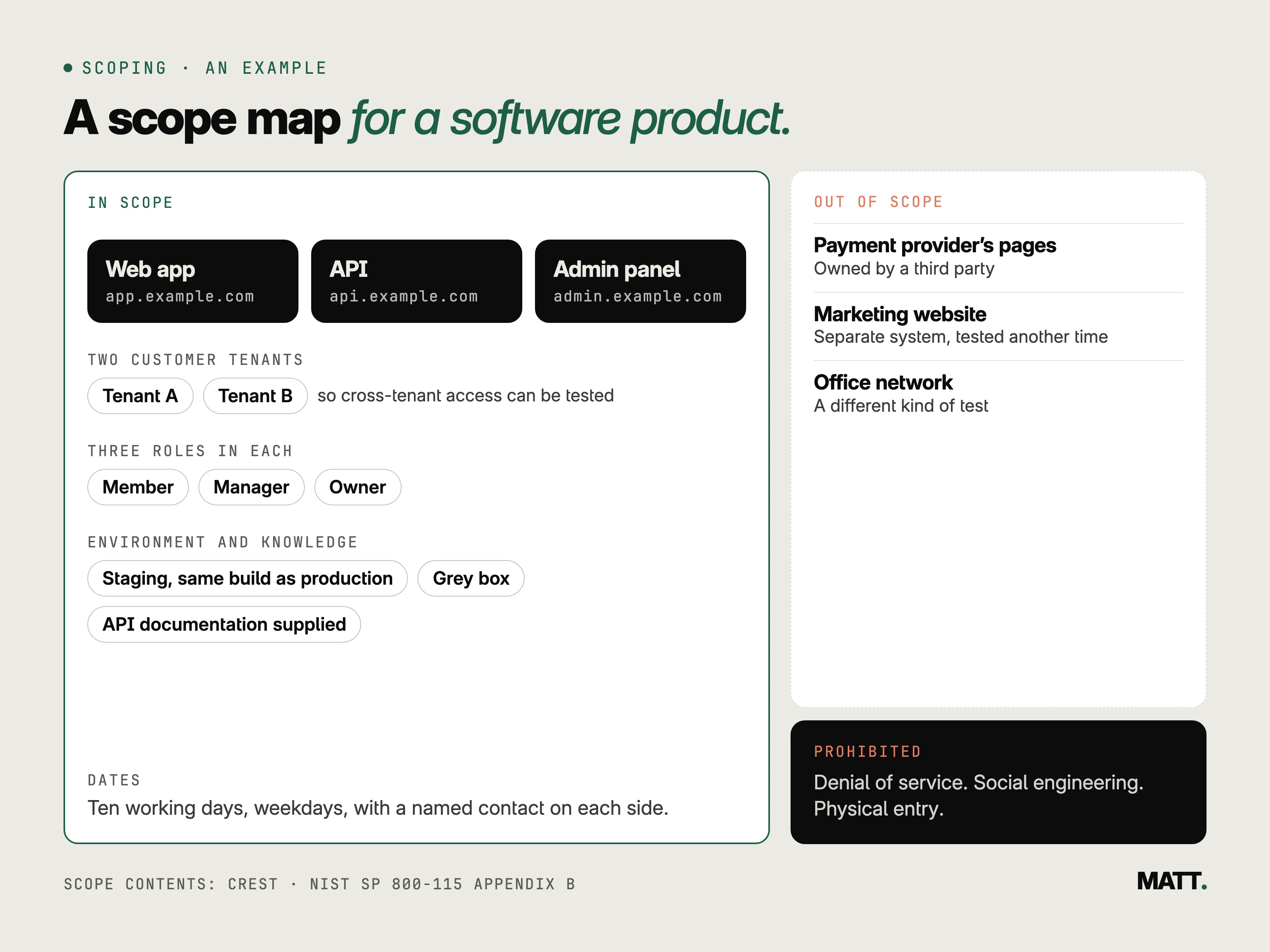
Write these down before asking for quotes. CREST’s buyer’s guide ↗ lists most of them as the contents of a proper scope statement. MATT’s pentest scope builder turns the same answers into a document you can send to providers.
- →Targets. Every application, API, address range and cloud account in scope, by name and address.
- →Exclusions. What must stay untouched: a payment provider’s pages, a shared platform, a fragile legacy system.
- →Environment. Production, staging or both. If staging, how closely it matches production.
- →Roles and accounts. One or two accounts for each kind of user, in at least two separate customer tenants. Cross-tenant flaws cannot be tested with one tenant.
- →Knowledge given. Black, grey or white box, and which documents and code the testers will receive.
- →Prohibited techniques. Denial of service, social engineering and physical entry are out unless written in.
- →Dates and hours. When testing may run, and any freeze periods.
- →Contacts. A named person on each side, reachable at any hour during the test.
- →Data handling. What the testers may copy, where they keep it, and when it is destroyed.
- →Deliverables. The report format, a debrief call, and a retest with its own date.
What a good report contains
The report is what you are paying for. The PCI guidance gives an outline that most serious providers follow, whatever the reason for the test:
- →Executive summary: what was found, in terms a board can act on.
- →Statement of scope: exactly what was tested.
- →Statement of methodology: how, and against which reference.
- →Statement of limitations: what was left out or cut short, and why.
- →Testing narrative: what the testers did, in order.
- →Findings: each with a description, the affected target, how exploitable it is, its severity, and references.
- →Tools used, and a note on cleaning up anything the testers created.
For each finding, the NCSC expects three things: the issue, the tester’s view of its risk, and a recommended fix. A finding you can act on has two more: the exact steps to reproduce it, and evidence that it worked.
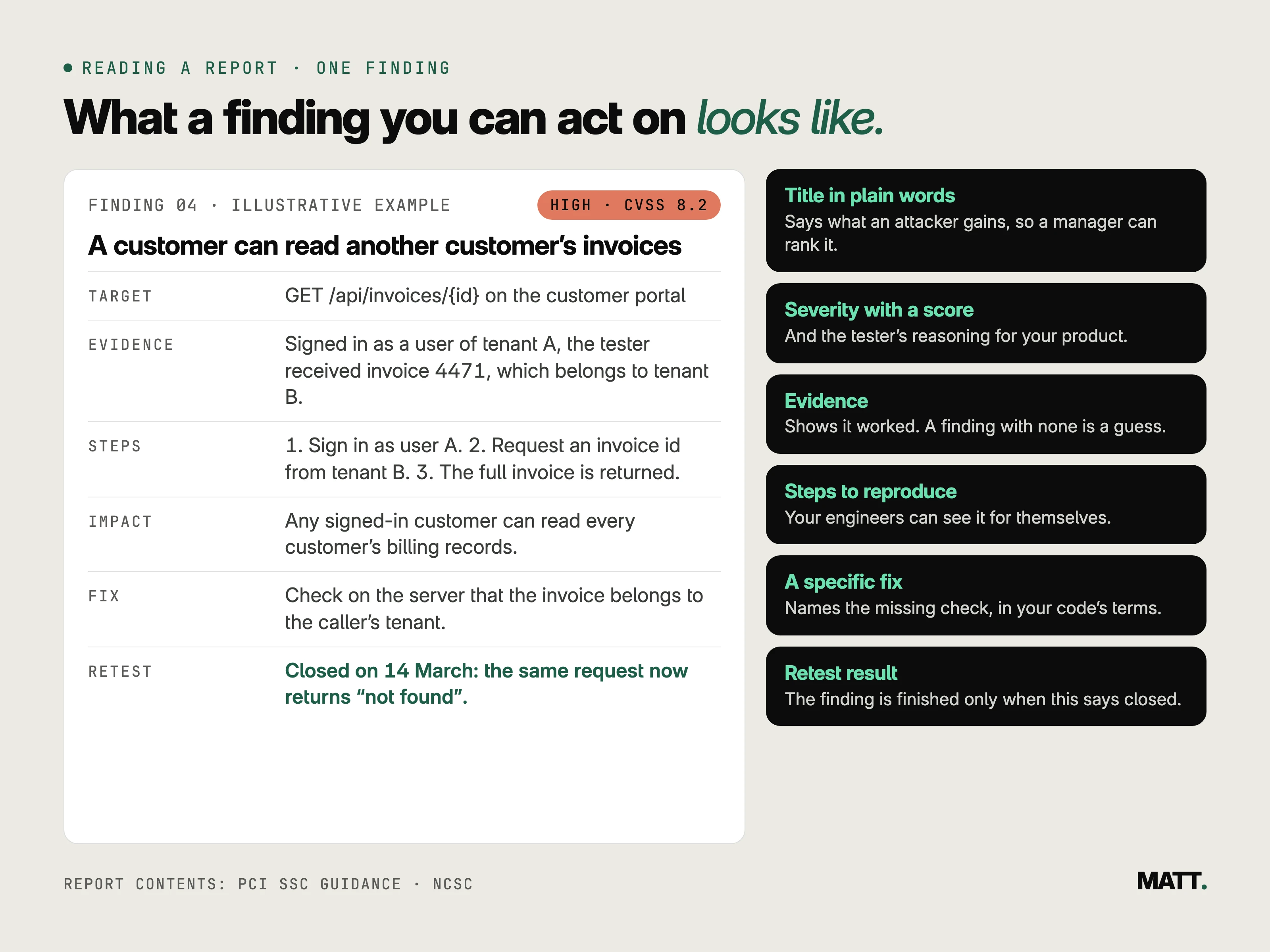
Severity is usually given with the Common Vulnerability Scoring System ↗, maintained by FIRST. Version 4.0 scores each flaw from 0 to 10.
| Rating | CVSS 4.0 score | A reasonable response |
|---|---|---|
| Critical | 9.0 to 10.0 | Fix now; consider taking the feature offline |
| High | 7.0 to 8.9 | Fix in days |
| Medium | 4.0 to 6.9 | Fix in the next planned release |
| Low | 0.1 to 3.9 | Fix when the code is next touched |
The response column is MATT’s suggestion; the score bands are FIRST’s. A score describes the flaw in general. What it means for your product depends on what sits behind it, so read the tester’s reasoning as well as the number.
To see real reports before you buy, open a few. A long-running public collection ↗ gathers reports that firms and their clients chose to publish, and Cure53 ↗ and Trail of Bits ↗ publish many of their own reviews of open-source projects. Ten minutes with two of them shows what good looks like.
Twelve questions to ask any provider
The first nine come from the PCI and CREST guidance. The last three are MATT’s additions.
- →Who will do the work? Names, experience and certifications of the testers on your job.
- →What have they tested that resembles our product? Same technologies, same kind of application.
- →Which methodology do you follow? Expect a named public reference for each target.
- →How much is manual? Ask for the split between tool time and hands-on time.
- →Are the testers independent of the people who built or run the system? PCI asks for organisational independence.
- →How are staff vetted, and what insurance do you carry? CREST lists both.
- →How will you handle our data? Storage, access, retention and destruction.
- →How will you keep us informed during the test? Daily notes are a fair expectation.
- →Is a retest included, and for how long is it available?
- →Can we see a sample report? A redacted real one tells you more than a brochure.
- →Does anyone outside your firm touch our test? Subcontracting should be declared.
- →How fast will we hear about a critical finding? Same day is the right answer.
What decides the cost
This guide gives no figures; quotes vary too widely for a number to help. What moves the quote is knowable. The NCSC notes that effort is usually expressed in days of tester time, and the PCI guidance says an engagement may last days or weeks depending on scope and size.
- →Size of the target: the number of applications, API endpoints, user roles and address ranges.
- →Depth: black-box work takes longer for the same coverage.
- →Complexity: multi-tenant products, payment flows and unusual technology need more days.
- →Constraints: testing only at night, or only in a slow staging environment, stretches the calendar.
- →Reporting and retest: a debrief and a retest are days too. Check the quote includes both.
When comparing quotes, compare days and names. Two quotes at the same total can differ by half in hands-on time. The Penetration Testing Execution Standard advises providers to add a fifth to their estimate for the unexpected; a quote with no slack at all tends to end with untested corners.
Certifications, and what they tell you
| Name | Issued by | What it shows |
|---|---|---|
| OSCP ↗ | OffSec | The holder passed a 24-hour practical exam. It is a personal skill |
| CREST CRT and CCT ↗ | CREST | Registered and certified tester levels. CREST also accredits firms |
| GPEN ↗ and GWAPT | GIAC | Exam-based certificates in network and web application testing |
| CHECK ↗ | UK NCSC | Approval to test UK public sector and critical national infrastructure systems |
The PCI guidance names several of these as useful indicators and adds that certifications alone are a weak guide; past work on similar systems matters more. Read them as a floor.
When a rule requires a test
| Rule | What it asks for | Who it applies to |
|---|---|---|
| PCI DSS | Internal and external penetration tests at least once a year and after significant change, by a qualified and independent tester (requirement 11.4 in version 4.0.1; see the Council’s guidance ↗) | Anyone who stores, processes or transmits card data |
| SOC 2 | The criteria name no mandatory penetration test. Many auditors expect one as evidence for the monitoring criteria | Service providers seeking a SOC 2 report. Ask your auditor what they will accept |
| HIPAA | A rule proposed in January 2025 ↗ would require a test at least every 12 months. Check its current status | US healthcare organisations and their business associates |
| DORA | Threat-led penetration testing ↗ at least every three years for firms the authorities designate; yearly testing of systems behind critical functions | Financial firms in the EU |
| FedRAMP | A test by an accredited assessor at authorisation and at least every 12 months after | Cloud services sold to US federal agencies |
What a penetration test cannot tell you
The NCSC is direct about this: a test shows that you were free of the known issues it looked for on the day of the test. It recommends using tests to check that your own process for finding and fixing weaknesses is working, much as a financial audit checks the books. CREST lists the same limits: a test covers only the chosen target, it is a snapshot, and it can miss things.
Software now changes daily, and attackers have new help. In March 2026 the NCSC and the AI Security Institute wrote ↗ that AI tools are making vulnerability discovery faster and broader, and that defenders should assume some attackers have capable AI. At DARPA’s AI Cyber Challenge final ↗ in August 2025, automated systems found 54 of 63 planted vulnerabilities across more than 54 million lines of code, and 18 real ones.
So plan for what happens between tests. NIST suggests regular scanning between annual tests. A stronger habit is to turn each finding into a check that runs on every release, so a fixed flaw stays fixed. That is the part of the problem MATT works on: it tests a product the way an AI-assisted attacker does, writes each finding as a plain-English rule with a check, and re-proves the rules on every release. It sits beside a penetration test, and the side-by-side comparison shows where each fits.
Warning signs in a quote or a report
- →The proposal names tools and gives no tester names.
- →No one asks for accounts in more than one role or tenant.
- →The report arrives the day after testing ends and reads like tool output.
- →Findings have a severity and no steps to reproduce.
- →There is no statement of what was left untested.
- →A retest is offered only as a new engagement.
- →The provider is relaxed about written authorisation.
Sources
- →NIST: SP 800-115, Technical Guide to Information Security Testing and Assessment ↗
- →UK NCSC: Penetration testing guidance ↗; Why cyber defenders need to be ready for frontier AI ↗
- →PCI Security Standards Council: Penetration Testing Guidance, v1.1 ↗
- →CREST: A Guide to Penetration Testing ↗, 2022
- →PTES: Pre-engagement interactions ↗
- →OWASP: Web Security Testing Guide ↗, API Security Top 10 2023 ↗, Mobile Application Security Testing Guide ↗
- →FIRST: CVSS v4.0 specification ↗
- →Iowa Judicial Branch: statement of 18 September 2019 ↗ and the independent review ↗
- →DARPA: AI Cyber Challenge results ↗
Questions
What do penetration testing services include?
A defined scope, rules of engagement, a period of hands-on testing by named testers, a written report with each finding’s evidence, severity and fix, a debrief, and a retest of the fixes. If any of these is missing from a quote, ask why.
What is the difference between a penetration test and a vulnerability scan?
A scan is mostly automated and reports known weaknesses. A penetration test is manual: people exploit weaknesses, chain them and show what an attacker could reach. The PCI Security Standards Council’s guidance draws the line in the same way.
How long does a penetration test take?
The PCI guidance says days or weeks, depending on scope and size. Effort is usually quoted in days of tester time. Add time for scoping before the test and for the report, fixes and retest after it.
How often should we run a penetration test?
PCI DSS asks for one at least yearly and after significant change. NIST suggests annual testing with regular scanning in between. The NCSC notes that a test only reflects the day it was run, so plan for checks between tests.
Does SOC 2 require a penetration test?
SOC 2’s criteria name no mandatory penetration test. Many auditors expect one as evidence, so ask your auditor what they will accept before you buy.
Black box, grey box or white box?
For a software product, grey box usually gives the most for the time: testers get accounts in each role and some documentation. PCI’s guidance notes black-box tests can take more time and money for the same depth.