Artex: the FBI's warning about an AI hacking tool anyone could download
The FBI says Artex, a free AI penetration-testing tool, breached networks in under three hours, from ConnectWise customers to Barracuda. What to check now.
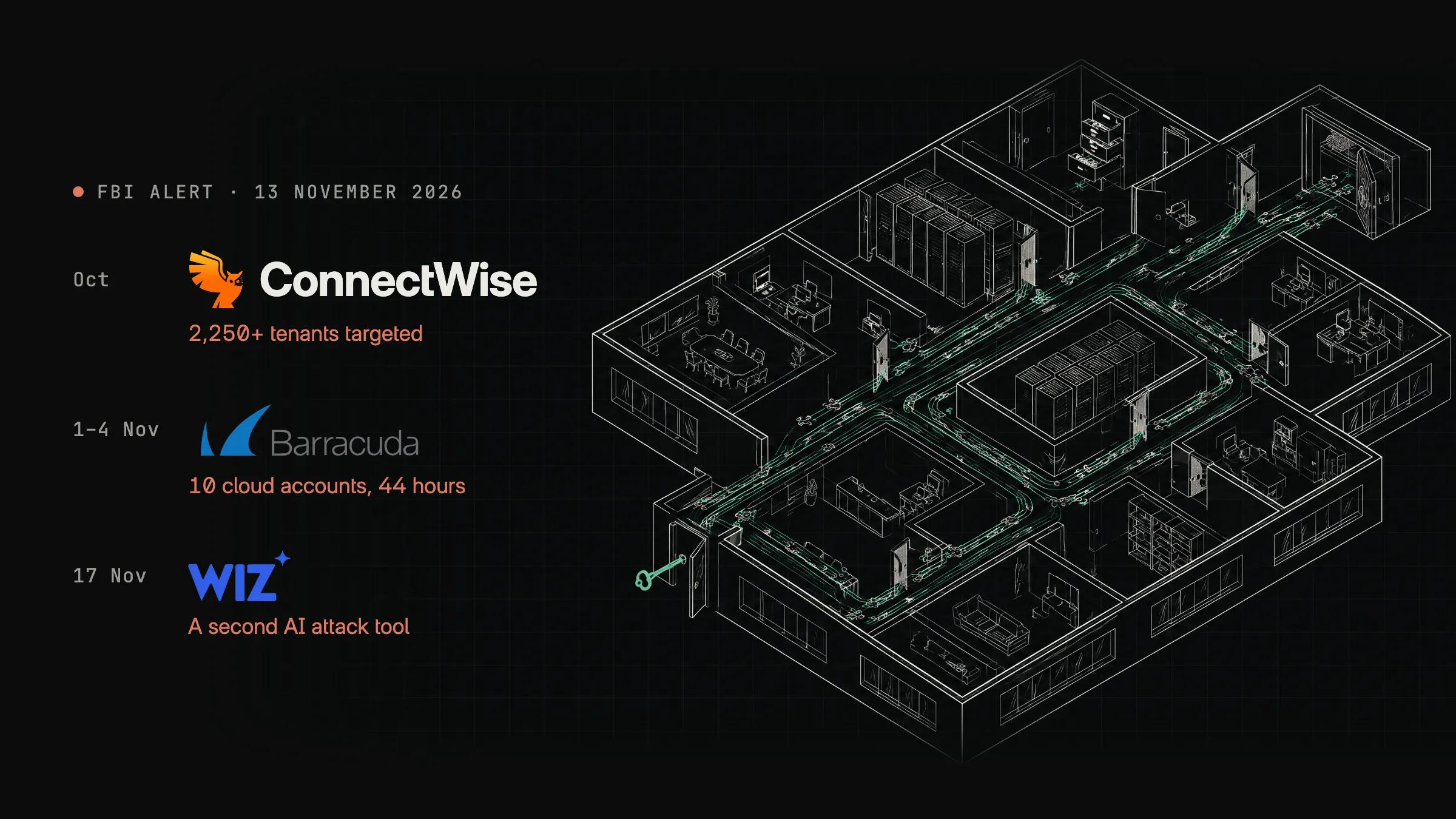
On 13 November 2026 the FBI warned that Artex, a free AI penetration-testing tool first published on GitHub in July, is being used by criminals and state-aligned groups to break into organisations in at least ten sectors, some intrusions going from first probe to privileged access in under three hours. The tool hands a language model the work of planning and running an attack. The FBI ties it to a supply-chain attack on ConnectWise customers and to the theft of personal data on about 67,000 people from South Korean financial institutions (FBI ↗).
The alert names no single attacker. Microsoft attributes the ConnectWise campaign to a China-aligned group it calls Storm-0940; Amazon saw several Chinese-nexus groups; Barracuda describes a financially motivated intruder. What they share is the tool, and a pace that left defenders reading the logs after the attacker had finished.
ExploitOps WeeklyStories like this one, by email every Friday.Subscribe
What Artex is
Artex is an open-source program with a web console. A user types a goal, such as gaining admin access to a target; a planner agent turns it into tasks, worker agents carry them out with ordinary tools such as the network scanner nmap, and each result goes into a shared map of the target that the next agent reads (Censys ↗). It has no model of its own and connects to any: the FBI lists Anthropic's Claude and OpenAI's GPT alongside DeepSeek, GLM, Grok and Kimi. In the attacker-run consoles it analysed, Chinese models were the most common, DeepSeek's Flash models above all, which the FBI puts down to their low cost and their lack of observable guardrails when a request is framed as penetration testing (FBI ↗).
Its developer, who publishes as Autumn-27, released it in July as a tool for authorised testing within agreed limits and took the repository down on 8 October, the day after CrowdStrike reported criminal use. Copies live on through community forks, archives and a commercial edition, Artex Pro, the FBI says.  Censys counted 1,465 internet-facing Artex consoles on 4 November; the FBI puts the figure at more than 1,600 by early November (Censys ↗).
Four intrusions, as the people who saw them tell it
| When, and who reports it | Target | What happened | How fast |
|---|---|---|---|
| Aug–Oct · FBI ↗, citing CrowdStrike and Zscaler | South Korean financial institutions | Personal information on about 67,000 people taken | Not published |
| Oct · Microsoft ↗ |  ConnectWise Cloud Backup customers | After taking control of ConnectWise's cloud applications, the agents attempted sign-ins to more than 2,250 customer Microsoft 365 tenants | Several attacks reached privileged access in under three hours |
| 1–4 Nov · Barracuda ↗ |  Barracuda | A cloud key left with a former vendor opened about 10 cloud accounts, including the store of credentials its XDR service uses | About 44 hours, over before anyone noticed |
| Oct–Nov · Amazon ↗ | AI service keys and two crypto exchanges | Agents stole AI keys to pay for their own models, and built deepfakes to pass identity checks | Four agent sessions working at once on one goal |
Microsoft is careful about the ConnectWise numbers: a successful sign-in through an affected application does not necessarily mean customer data was read or taken, and ConnectWise told TechCrunch it cannot confirm how many environments were reached (TechCrunch ↗).
Forty‑four hours inside Barracuda
Barracuda's own account, published on 11 November by its chief information security officer, Arve Kjoelen, is the clearest picture yet of what an Artex intrusion looks like from the inside. Nothing was broken open. Barracuda had given a cloud access key to a vendor, an AI company, for an earlier project and never retired it; "That is on us," Kjoelen writes. In October the vendor's development environment was breached, which appears to be where the attacker found the key (Barracuda ↗).
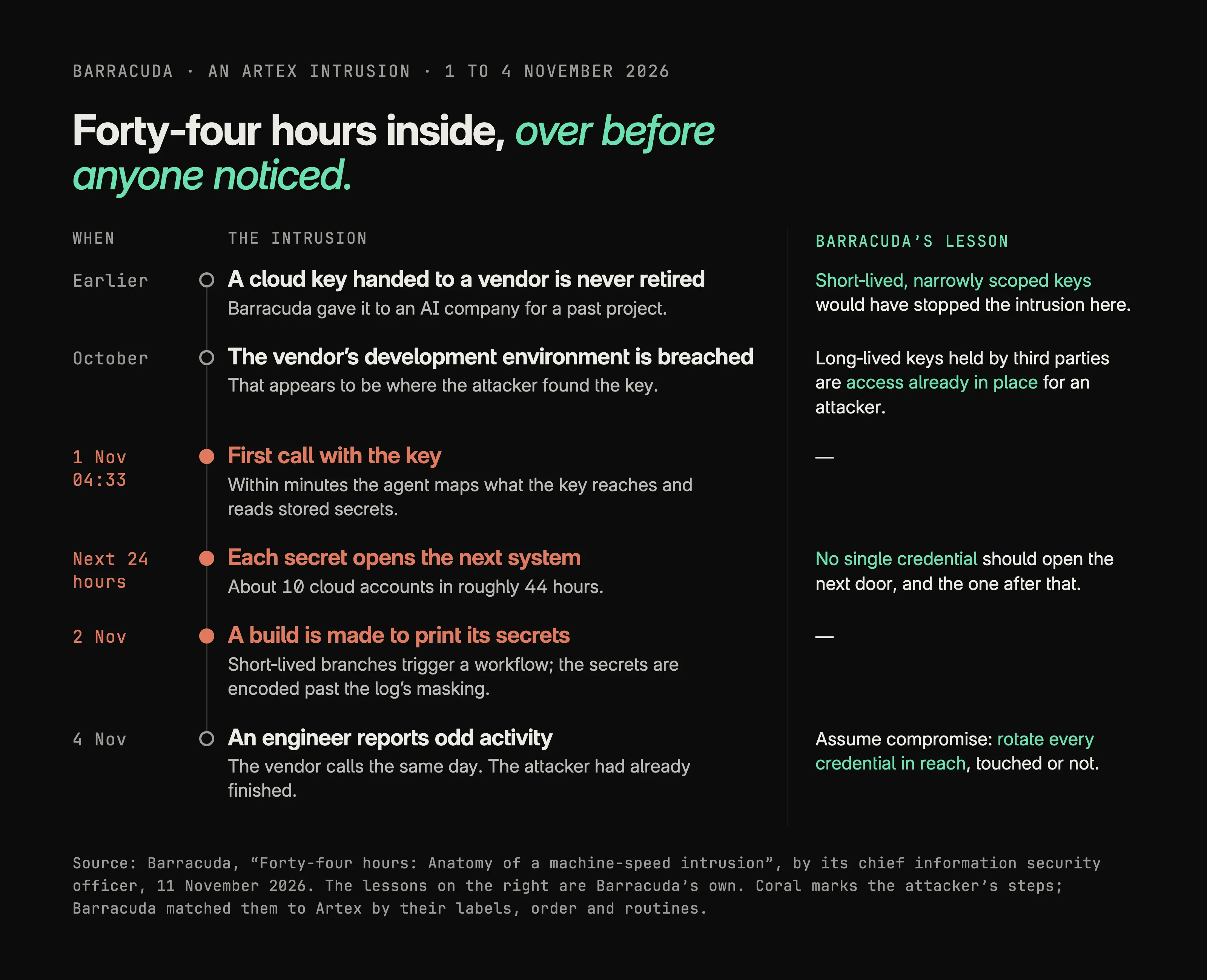
The first call with the key came at 04:33 on 1 November. Within minutes the attacker was mapping what the key could reach and reading stored secrets, AWS access keys and Azure service secrets among them, and each secret became the way into the next system. Early on 2 November it pushed short-lived branches to a few code repositories to make a build print its secrets into the job log, encoded so the log's masking would miss them. It named everything it created with the letter i and a string of digits. Those labels, the order of its work and its routines for hunting credentials and cryptocurrency wallets all matched Artex.
On 4 November an engineer reported unusual activity on their own account, and the vendor called the same day about its own breach. By then the attacker had already stopped; its run had lasted under two days. One system it reached holds the credentials Barracuda's XDR service uses to collect data from customers; Barracuda found no direct evidence they were viewed, could not rule it out from its logs, and so rotated everything in reach and asked the affected customers to replace their integration keys. Barracuda's conclusion is blunt: an attacker that crosses five platforms in under two days will usually finish before detection and response begin, so the weight has to move to preventing access and recovering quickly.
Why the speed matters
Microsoft makes the same point about Storm-0940. Agents work around the clock, at weekends and on holidays, and try several ways in at once. Their traffic is loud enough to trigger alerts, and fast enough that the attack is often over before anyone acts on them (Microsoft ↗). The FBI calls this a compressed detection window, and says the tool favours whatever gets the least attention: partner and supplier portals, mobile backends, employee and sales-support apps, legacy services, integrations and apps built by other business units.
Amazon saw the same operations from an unusual angle. Its decoy sensors, set up to look like AI model services, received requests from Artex agents that carried their own working memory: goals, tool histories and findings from whole campaigns. The biggest was a self-funding hunt for AI keys, in which each stolen key paid for the model calls that hunted for the next. Amazon's reading is that every technique was old; what changed was speed and persistence, and the agents got in where the basics were missing: default or hard-coded passwords, keys left in code and public files, interfaces with no sign-in, and unpatched software (Amazon ↗).
A second AI attack tool, the same week
On 17 November at 20:35 UTC a poisoned version of agent-framework, Microsoft's Python package for building AI agents, appeared on PyPI, the main registry for Python software. A second followed 33 minutes later; both were gone by 21:30. The package gets about 41,000 downloads a week. Installing either version planted a file that Python runs every time it starts, which gathered cloud and build-pipeline credentials, Azure above all, and posted them to a public webhook (Wiz ↗).
 Wiz could watch part of the operation because the attacker's tooling reported its progress to the same webhook. That tooling called itself Cairn, another open-source AI penetration-testing framework. Before publishing, the attacker ran the stealer on their own machine, which captured the settings of an AI coding agent backed by a GLM-family model. The attacker appears to have held a certificate and private key for the internal Microsoft service that signs and publishes the package: a first upload from AWS was blocked by that service's address filter, and a second, from Microsoft-owned address space, went through. How the key was obtained is unknown, and nothing published links Cairn to Artex. It follows OPTIMJACK on 16 November and nine AI developer platforms breached in October in a run of attacks on the software suppliers other companies trust.
Since the FBI's alert
On 23 November the incident-response firm NVISO reported something new: an Artex intrusion in Belgium that left behind ZQAgent, a stealthy backdoor that runs code, moves files and tunnels network traffic, and disguises itself as a standard Linux system process. Until then, NVISO says, Artex intrusions had mostly been smash-and-grab: stolen credentials, little left behind, contained by cutting off the way in and revoking the keys. A lasting foothold changes that, and NVISO believes the operator asked for it (NVISO ↗).
Copies of the tool carry their own risk. After the developer took Artex down on 8 October, a copy on GitHub changed one line so that installations pulled a Docker image with a hidden backdoor, which ran any command typed into the login form as root. It was downloaded more than 9,000 times before Docker removed it on 5 November, StepSecurity reports (StepSecurity ↗).
On 24 November The New York Times reported, citing US officials and people familiar with the matter, that the intruders behind a breach of an unclassified open-source intelligence system used by the CIA and the Office of the Director of National Intelligence apparently used Artex. Nextgov/FCW reported that Artex was also used in a separate, low-impact intrusion into the Defense Department's Cyber Defense Command (Gizmodo ↗, Nextgov/FCW ↗). The same day the Treasury's FinCEN disclosed an intrusion of its own that no outlet has tied to Artex; our developing story on the FinCEN breach follows both.
What to check this week
- →List every door, including the side ones. Inventory every internet-facing application, the partner portals, mobile backends and integrations included, and keep administrative interfaces, backup platforms and deployment endpoints reachable only from trusted networks, as the FBI recommends (FBI ↗).
- →Retire keys when the work ends. List the long-lived credentials held by vendors and former vendors, then revoke them or replace them with short-lived, narrowly scoped ones. Barracuda says that change alone would have stopped its intrusion at the first step (Barracuda ↗).
- →Check what connected apps can do. ConnectWise customers are asked to review every Microsoft 365 tenant where its applications were ever authorised, searching by application ID, from at least 1 October, and to preserve the logs before deleting anything (Microsoft ↗).
- →Look for secrets where the agents look. Amazon's agents searched code repositories, package files, container layers, notebooks and paste sites for keys. Scan the same places continuously and rotate whatever turns up (Amazon ↗).
- →Treat agent-framework 1.26.1 and 1.26.2 as a breach. Any machine or build pipeline that installed either should have its credentials rotated; 1.26.0 is the last clean version (Wiz ↗).
- →Check which Artex your own testers run. If anyone in the company has used Artex for authorised testing, find out which copy and which Docker image they installed, and rotate any credentials the backdoored image could have seen (StepSecurity ↗).
- →Watch AI spend. Stolen AI keys show up as unexpected usage and spend. Amazon advises bringing model gateways and inference endpoints under the same controls as other production systems.
Written down as rules a team can test on every release, those checks read: no credential issued to a former vendor still works; no administrative interface answers from the public internet; no secret sits in a repository, package or image; every connected application holds only the permissions its job needs. Against attackers who finish in hours, each rule is worth re-checking every time the systems change.
What we don't know
- →How many organisations Artex has reached. The FBI counts exposed consoles, which is a different number from victims, and says total deployments are likely far higher.
- →Who Barracuda's vendor was. Barracuda describes it only as a company working in AI whose development environment was breached in October.
- →What the ConnectWise sign-ins reached. Microsoft saw follow-on activity in several tenants and has not published how much data, if any, left them.
- →Who ran the agent-framework attack. Wiz has not attributed it, and how the signing key was obtained is still unknown.
Sources
- →Federal Bureau of Investigation, FLASH-20261113-001: Threat Overview of ARTEX Autonomous Penetration Testing Framework ↗, 13 November 2026
- →Microsoft Threat Intelligence, AI-driven, large-scale nation-state campaign using ARTEX enables supply chain compromise ↗, 21 October 2026
- →Barracuda, Forty-four hours: Anatomy of a machine-speed intrusion ↗, 11 November 2026
- →Amazon Threat Intelligence, Threat actors running cybercrime campaigns with ARTEX AI agents ↗, November 2026
- →Censys, ARTEX: Agentic Asbestos ↗, 5 November 2026
- →Wiz Research, Microsoft agent-framework compromised ↗, 17 November 2026, updated 18 November
- →NVISO, ARTEX leads to persistent ZQAgent backdoor ↗, 23 November 2026
- →StepSecurity, ARTEX: attackers adopted this AI pentesting tool in three months ↗, November 2026
- →TechCrunch, FBI says Artex AI open source hacking tool used to breach networks in under three hours ↗, 16 November 2026
Company logos identify the organisations named in public statements and imply no affiliation with MATT.
Questions
What is Artex?
Artex is an open-source AI penetration-testing framework first published on GitHub in July 2026. A planner agent turns a goal into tasks that worker agents carry out with standard tools, using whichever language model it is connected to. The FBI warned on 13 November 2026 that criminals and state-aligned groups use it to automate intrusions.
What did the FBI say about Artex?
In a FLASH alert on 13 November 2026 the FBI said Artex has been used since at least August 2026 against organisations in financial services, government, technology, defence, energy, healthcare and other sectors, with some intrusions reaching privileged access in under three hours, and that copies keep circulating after its developer took it down.
Which AI models does Artex use?
It has no model of its own and connects to any provider. The FBI lists Claude, GPT, DeepSeek, GLM, Grok and Kimi, and says DeepSeek's Flash models were the most common in the attacker-run consoles it analysed.
How did Artex get into Barracuda?
Through a valid cloud access key Barracuda had given a vendor for an earlier project and never retired. The vendor's development environment was breached in October; from 1 November the attacker touched about 10 cloud accounts in roughly 44 hours, Barracuda says.
Was the Microsoft agent‑framework compromise linked to Artex?
Nothing published links them. Wiz says the attacker's tooling identified itself as Cairn, a different open-source AI penetration-testing framework. Versions 1.26.1 and 1.26.2 were malicious, and 1.26.0 is the last clean version.