OPTIMJACK: how poisoned Optimizely scripts hit 178 brands in one day
An attacker wrote malware into the Optimizely snippets of Zoom, the BBC, CNN, HSBC and 174 more. What the code did, who was hit, and what to check now.

On 16 November 2026 an attacker wrote malicious code into the Optimizely Web projects of at least 178 organisations, so that their own trusted Optimizely snippets served every visitor a cryptocurrency-address swapper, a card skimmer, cookie and screenshot theft and, on iPhones and iPads, the Coruna and DarkSword exploit kits. Report URI, the company of security researcher Scott Helme, found the code in 188 of the 1,611 snippets it checked, including those of Zoom, the BBC, CNN, Salesforce, GitLab, IKEA, HSBC, Equifax and Air France-KLM (Report URI ↗).
Most of it was removed within a day: at 21:52 UTC Report URI found the code in one snippet out of 188, down from 169 an hour earlier. How the attacker got write access to so many unrelated customers' projects has not been explained. The name OPTIMJACK comes from the first public write-up, by Amirul Cyber ↗.
Latest
This is a developing story. Times are UTC.
- →16 November, 23:10. Optimizely has published no statement on the attack. Its status page ↗ lists a partial outage of Recommendations tracking and reporting, under investigation since 16:29, without linking it to the injected code.
- →16 November, 21:52. One of 188 infected snippets still carries the code, Report URI says, after a mass clean-up between about 20:40 and 21:10.
- →16 November, evening. Hudson Rock recovers eight poisoned Optimizely files and traces an earlier wave through three other script providers (Hudson Rock ↗).
What happened
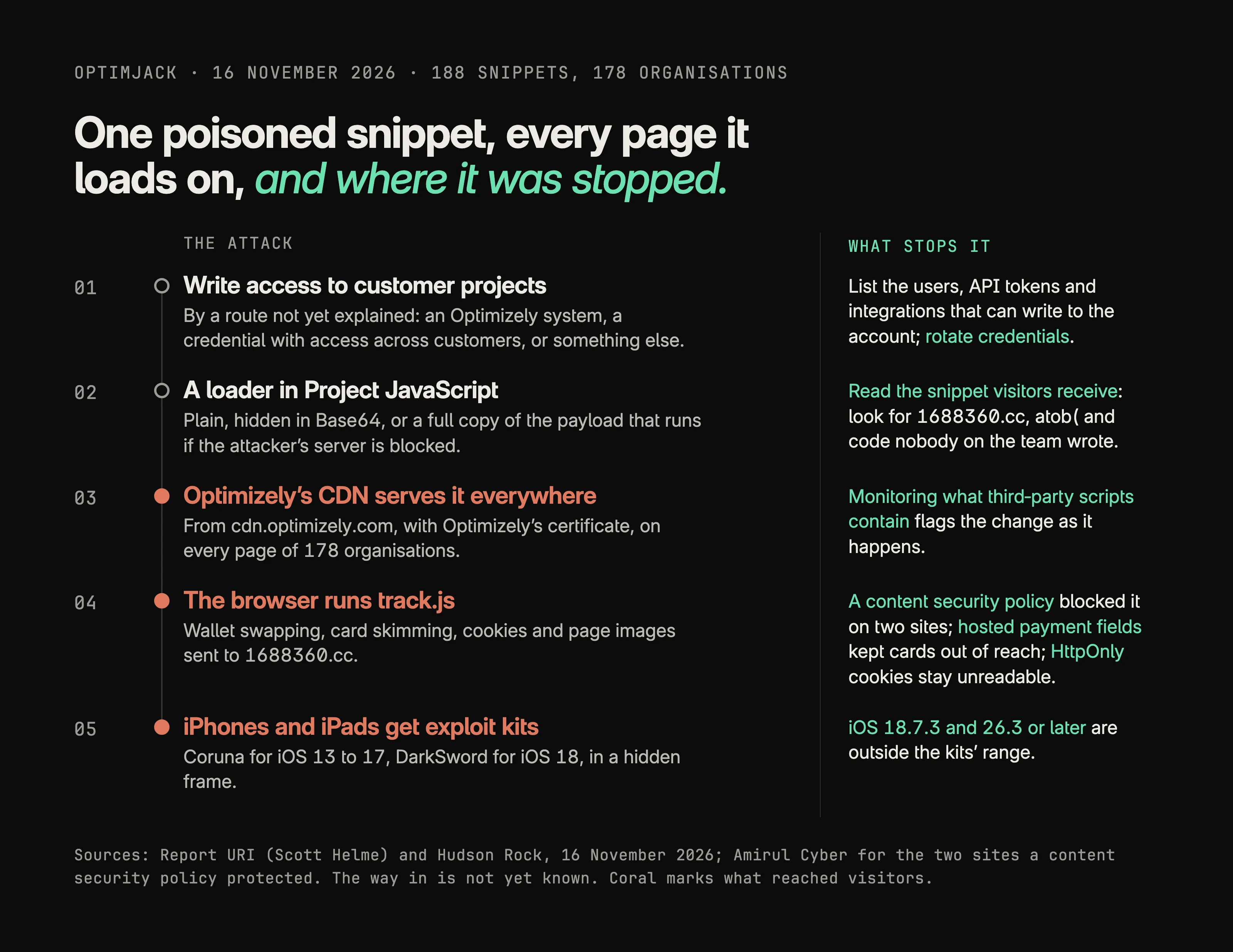
Optimizely Web is a tool for testing changes to a website. Each customer site loads a JavaScript file, the snippet, from Optimizely's servers on every page. The snippet carries Optimizely's own code, the customer's experiments and a field called Project JavaScript: custom code the customer writes in the Optimizely dashboard, which runs on every page.
The attacker wrote their own code into that field in customer projects and left the rest of each snippet alone. The file still came from cdn.optimizely.com, with Optimizely's certificate, from a host every affected site already trusted. Report URI says Optimizely's servers delivered exactly what the projects contained; the change was in the projects themselves. Optimizely's own sites, www.optimizely.com and login.optimizely.com, carried the code too.
Report URI saw three versions of the injected loader: a plain script tag pointing at the attacker's server, 1688360.cc; the same address hidden in Base64, which a text search for the domain misses; and a full copy of the payload inside the snippet, which runs if the attacker's server is blocked. One customer's snippet, Smartsheet's, was cleaned and then infected again with the hidden version, "so whoever wrote the code still had access at the time", Report URI writes.
What the code did
Every visitor received the same script, track.js, and every part of it was active at once. The attacker rebuilt it 26 times during the day, adding features and wallets, Report URI found.
- →Wallet swapping. It found valid cryptocurrency addresses for Bitcoin, Ethereum and other EVM chains, TRON, Solana, TON, Litecoin, Bitcoin Cash and Dogecoin, checked their checksums, and replaced them with the attacker's in page text, form fields, links, the clipboard and outgoing requests. A visitor who copied an address from an affected page could paste the attacker's.
- →Card skimming. Added at 13:43 UTC, it watched form submissions for a card number, expiry and security code and sent all three to the attacker. Cards typed into a payment provider's hosted field, such as Stripe's or Adyen's, were out of its reach; cards typed into a site's own form fields were not.
- →Cookies and screenshots. When it swapped an address next to wallet or payment wording, it sent the page address, the cookies a script can read, the original addresses and a rendered image of the page.
- →iPhone and iPad exploit kits. On Apple mobile devices it loaded routers that serve the Coruna kit to iOS 13 to 17 and DarkSword to iOS 18, in a hidden frame. The kit's own comments say iOS 18.7.3 and later, and 26.3 and later, are patched, according to Report URI. Hudson Rock recorded the routers serving their entry pages and stresses that this shows delivery, with no successful compromise of a real device demonstrated.
By 19:25 UTC the attacker's wallets had received about $7,040, all within roughly nine hours, and the funds were swept to exchanges from 13:03 UTC. Report URI cannot see how many cards or cookies reached the attacker's server. One of the wallets, on TRON, has been in use since March 2026.
Who was hit
Report URI checked 1,611 Optimizely snippets it could find and kept a copy of each of the 188 infected ones. It says the real number is likely higher. By sector:
| Sector | Organisations | Examples |
|---|---|---|
| Banking and finance | 32 | Paychex, HSBC in 11 markets, Equifax, ABN AMRO, TaxAct |
| Technology and software | 23 | Zoom, Salesforce, GitLab, Bitly, Optimizely |
| Retail and fashion | 20 | IKEA, ASOS, Mattel, American Eagle |
| Streaming and entertainment | 12 | Peacock, D&D Beyond, NOW TV |
| News and media | 10 | CNN, BBC, Fox News, NPR |
| Airlines and travel | 9 | Air France-KLM, Alaska Airlines, Transavia |
| Healthcare and pharma | 8 | Invisalign, Takeda |
| Telecoms | 7 | Virgin Media O2, Vodafone Australia |
| Crypto and trading | 6 | Ledger, IG, OANDA |
The Optimizely injection was the second wave. From 13 November the same actor's loader, webshell.lol, appeared in scripts served by three other providers, Kissmetrics, StorifyMe and Minute Media, on sites including Security Bank, the Frankfurter Allgemeine, the Sydney Morning Herald, vidaXL and Fox Sports (Hudson Rock ↗, Report URI ↗). The first Optimizely injection Report URI saw was in the BBC's snippet at 04:21 UTC on 16 November.
Was Monday's bank outage connected?
The same afternoon, customers of Chase, Bank of America, Wells Fargo and U.S. Bank reported they could not log in or move money. On Hacker News, under the Associated Press report of the outage, commenters wondered whether the two were linked; one wrote that "scuttlebutt on Twitter" blamed a compromised Optimizely script (Hacker News ↗).
The evidence so far points the other way:
- →Chase named a cause. Just before 4 p.m. Eastern it said the trouble was "a software bug in on-premise hardware systems" and that there was "no evidence this is cyber-related"; transactions with other banks were affected when Chase was party to them (Daily Voice ↗, CBS News ↗).
- →The outage banks are absent from the list. Chase, Bank of America, Wells Fargo, U.S. Bank, Truist and Capital One are missing from the 178 organisations Report URI found serving the code.
- →A page that loads Optimizely shows nothing on its own. The code was written into individual customer projects, so only the poisoned projects served it.
- →The payload needed working pages. A wallet swapper and a card skimmer earn only while customers can reach the site and pay; an outage starves them.
It was a week of loud failures. On Friday overloaded routers forced the Federal Aviation Administration into a nationwide ground stop; Microsoft restored Outlook and Teams on Saturday after a global outage it attributed to a technical issue, and Chase followed on Monday (CBS News ↗). The one confirmed attack of the week made no noise at all. We will update this section if any bank or investigator reports a link.
What to check now
If your site uses Optimizely Web, Report URI's advice is the place to start:
- →Read your own snippet. Open every project's Project JavaScript and every experiment's custom code, and look for 1688360.cc, atob( and any script nobody on your team wrote. Check the snippet your visitors actually receive, including any copy served from your own domain.
- →Review who can write to it. List the users, API tokens and integrations with write access to your Optimizely account, remove what you do not recognise and rotate the rest.
- →Treat 16 November as exposure. Cards typed into your own form fields that day, and session tokens in cookies without the HttpOnly flag, should be treated as exposed and rotated or re-issued.
- →Limit what scripts may contact. A content security policy that lists the hosts your pages may load from and send to, with reporting switched on, blocks or reports a script that reaches somewhere new. On two affected sites a policy stopped the payload from loading, Amirul Cyber found.
- →Watch the code you did not write. An experimentation snippet changes whenever an experiment does, so the control that fits is monitoring what each third-party script contains and where it connects.
- →Keep card entry in the payment provider's field. A hosted payment field sits in the provider's own frame, out of reach of scripts on your page.
If you visited an affected site on 16 November, update an iPhone or iPad to iOS 18.7.3 or 26.3 or later, check that any crypto transfer went to the address you meant, and watch your card statements.
Written down as rules a team can test on every release, those checks read like this: no script on our pages connects to a host we have not listed; a change to any third-party script on a page that takes payments raises an alert within minutes; card numbers are entered only in the payment provider's hosted field.
What we don't know
- →How the attacker got in. A compromised Optimizely system, a credential with access across customers, or something else: Report URI says that is for Optimizely to explain, and Optimizely has said nothing yet.
- →Whether one route served both waves. Hudson Rock links the Kissmetrics, StorifyMe, Minute Media and Optimizely waves through shared code and hosts, and says the way in for each is still unknown.
- →How many people lost money or data. The $7,040 traced to the wallets by 19:25 UTC is a floor; only the attacker can count the cards and cookies collected.
- →Whether any iPhone was compromised. The exploit kits were served; a successful exploit on a real device has not been shown.
- →Who is behind it. No researcher has attributed the attack.
Sources
- →Scott Helme, Report URI, World's Largest Brands Infected With Malware Via Optimizely ↗, 16 November 2026, and his first post on X ↗
- →Hudson Rock, Poisoned Scripts on BBC, Zoom and Other Major Websites Linked to iPhone Exploit Loaders ↗, 16 November 2026
- →Amirul Cyber, CNN, Zoom, Fox News Served Visitors a Crypto-Stealing Skimmer: OPTIMJACK ↗, 16 November 2026
- →Ohey, DarkSword router research ↗, November 2026
- →Optimizely, status page ↗
- →Daily Voice, Chase identifies outage cause ↗, and CBS News, Major U.S. banks report widespread service outages ↗, 16 November 2026
Questions
What is OPTIMJACK?
The name researchers gave to the 16 November 2026 attack in which malicious code was written into the Optimizely Web projects of at least 178 organisations. Their Optimizely snippets then served visitors a crypto-address swapper, a card skimmer, cookie and screenshot theft and, on iPhones and iPads, the Coruna and DarkSword exploit kits.
Which websites were affected?
Report URI found the code in 188 snippets belonging to 178 organisations, including Zoom, the BBC, CNN, Salesforce, GitLab, IKEA, HSBC, Equifax, Air France-KLM and Ledger. It says the real number is likely higher. Nearly all were cleaned by 21:52 UTC on 16 November.
Was Optimizely hacked?
The code was written into customer projects and served from Optimizely's own servers, including on Optimizely's own websites. How the attacker got write access across so many customers has not been explained, and Optimizely had published no statement by late on 16 November.
Was my iPhone at risk?
Visitors on iPhones and iPads were served exploit kits aimed at iOS 13 to 18. Report URI says iOS 18.7.3 and later, and 26.3 and later, are patched. Updating is the fix; no successful compromise of a real device has been shown.
Did OPTIMJACK cause the US bank outage on 16 November?
No evidence links them. Chase attributed its outage to a software bug in its on-premise systems and said there was no evidence it was cyber-related, and the banks in the outage are absent from Report URI's list of affected organisations.