exploit_agent: the AI that turns security fixes into attacks
Google found exploit_agent, an AI system that reads each new security fix, writes the attack and runs it with no human in the loop. How it works, what to check.

On 16 November 2026 Google's Threat Intelligence Group (GTIG) said it had seen attackers use AI to run vulnerability discovery and exploitation end to end, with no human in the loop, for the first time. The framework, which its operator called exploit_agent, compares popular web software before and after each security fix, works out what the fix closed, writes an exploit and runs it. Google found data taken from victims on the same server (Google Threat Intelligence Group ↗).
For anyone running software on the internet, the lesson is about time. A security fix describes the flaw it closes, and exploit_agent reads that description as soon as it is published. The hours between a vendor's release and your update are the window it works in.
What Google found
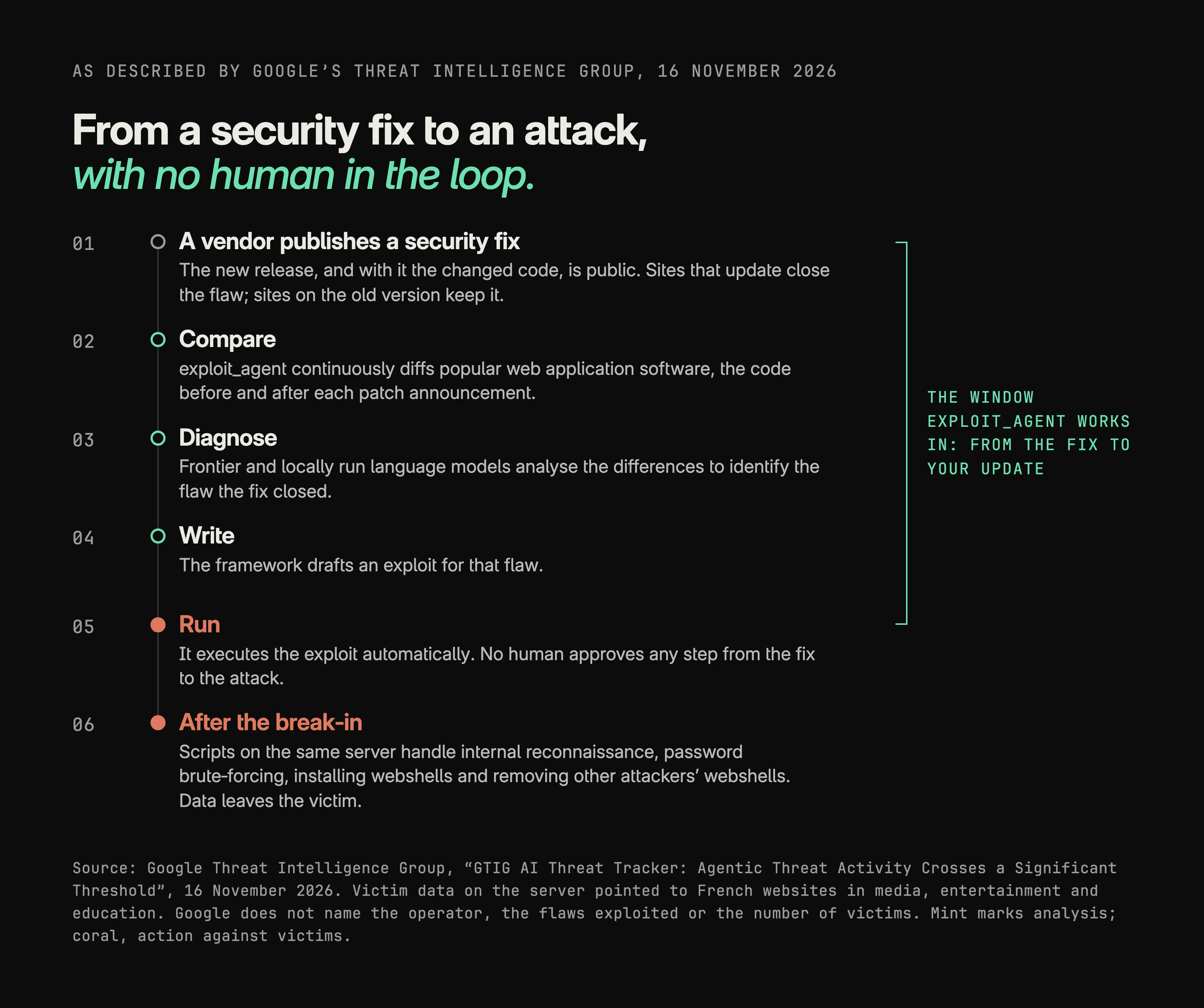
GTIG found an exposed staging server hosting a multi-agent framework connected to several frontier and locally run language models. Google describes it working in a loop:
- →Compare. It runs continuous differential analysis of popular web application software, comparing the code before and after each patch announcement.
- →Diagnose. It analyses the differences to identify the vulnerability a fix closed.
- →Write. It drafts an exploit for that vulnerability.
- →Run. It executes the exploit automatically, without human intervention.
The server also held data exfiltrated from victims and scripts for what comes after a break-in: internal reconnaissance, brute-forcing passwords, installing webshells and removing other attackers' webshells. Victim telemetry on the server suggested the operator was interested in French websites in media and entertainment, and in education.
One example in Google's report shows the framework reading an access check in Spectra, a popular WordPress plugin, at version 2.19.25. The check decides who may reach the plugin's popup route by searching the requested address for a path, and Google labels it an insecure capability check. Google does not say which flaw the framework went on to exploit.
A configuration file on the server carried comments in Russian. Google translates the first as "LLM API keys for auto-exploitation (exploit_agent pilot)"; the second asks whoever fills in the file to type the keys there. Google does not name the operator, the flaws exploited, the number of victims or how often the exploits worked.
Why a security fix is now the signal
A patch has always shown a careful reader where the bug was. Turning that into a working exploit used to take a skilled researcher days of reading code. Google's own numbers show where the growth in attacks has come from (GTIG, 30 September ↗).
- →From January to August 2026 GTIG recorded 141 vulnerabilities disclosed and exploited, more than the 127 exploited in all of 2025. Exploitation in the wild rose from an average of 10.5 a month to 18.
- →Zero-days, flaws attacked before any fix exists, rose only from 8 a month to 11, before a spike to 22 in August. GTIG puts most of the growth in the rapid weaponisation of n-days: flaws attacked after their fix is published.
- →Exploitation of high-risk vulnerabilities more than doubled, from 28 in 2025 to 75 in the first eight months of 2026.
- →Only about one disclosed vulnerability in 431 was seen exploited in 2026, so knowing which ones are being attacked matters more than the raw count.
Google gives a case from late August: attackers exploited two flaws in PaperCut print servers, researchers and the security company Huntress produced working exploits with language models within a day of disclosure, and GreyNoise reported a campaign four days after disclosure that went from a first foothold to domain administrator within minutes.
October showed the same pattern. In PHP2Shell, early patched code was public before the release, which let anyone compare versions; Google counts hundreds of non-working, likely model-written exploits published in the days after. In Broccoli2Shell, the fix sat readable in a public repository for almost eight months before a release carried it.
Where the AI fits
Every step Google describes, from reading the fix to running the exploit, is carried out by language models. People built the framework, supplied the API keys and decided what it pointed at.
Google also names the cost to attackers. The "forensically noisy nature" of many model-driven tools can give them away, and models can invent details or even targets. Speed comes with traces a defender can look for.
What to check this week
- →How long a fix takes to reach you. For every system on the internet, the content management system, its plugins and the frameworks behind it, measure the time from the vendor's security release to your update in hours. Turn on automatic updates for plugins where you can.
- →What you expose. List the plugins and components reachable from the internet and remove the ones nobody uses. Each one is a stream of fixes someone else is reading.
- →Cover for the gap. Where an update needs testing first, a web application firewall rule for the published flaw can protect the hours in between.
- →Signs of a break-in. New administrator accounts, PHP files in upload folders, bursts of failed logins, and webshells that appear and vanish. exploit_agent removed other attackers' webshells, so a tidy server can still be a compromised one.
- →Access decided by identity. An administrator route should answer according to who is asking, however the request is written. The Spectra check Google shows decided by reading the address.
Written down as rules a team can test on every release, those checks read like this: every internet-facing component runs a release without a known exploited flaw within an agreed number of hours of the fix; an administrator route answers only to an administrator's session; a file uploaded to the site never runs as code.
What we don't know
- →Who ran it. The comments are in Russian; Google does not attribute the operator.
- →Which flaws and how many victims. Google shows the framework analysing one plugin and names the sectors in the victim data, with no list of flaws or count of victims.
- →How well it works. No success rate, and no time from a patch to an attack, has been published.
- →Which models. Google says frontier and locally run models, without naming them.
Sources
- →Google Threat Intelligence Group, GTIG AI Threat Tracker: Agentic Threat Activity Crosses a Significant Threshold ↗, 16 November 2026
- →Google Threat Intelligence Group, Vulnerability Discovery and Exploitation Trends in the AI Era ↗, 30 September 2026
- →MATT, PHP2Shell: how an old flaw in PHP became an emergency and Broccoli2Shell: the fix that waited eight months
Questions
What is exploit_agent?
A multi-agent AI framework that Google's Threat Intelligence Group found on an exposed server and reported on 16 November 2026. It compares web software before and after security fixes, works out the flaw each fix closed, drafts an exploit and runs it without human intervention.
Did an AI really attack websites with no human involved?
Google says the framework ran from analysing a fix to executing the exploit without a human in the loop, and it found data taken from victims on the server. People built and configured the framework and chose what it targeted.
Which software did exploit_agent target?
Popular web application software, according to Google, whose example shows it reading a WordPress plugin, Spectra 2.19.25. Victim data on the server pointed to French websites in media, entertainment and education. Google has not listed the flaws it used.
What is patch diffing?
Comparing a program's code before and after a security fix. The lines that changed point to the flaw the fix closed, which tells an attacker what to aim at on systems that have not updated yet.
What should a company do about it?
Shorten the time from a vendor's fix to your update for everything on the internet, remove components nobody uses, cover the gap with firewall rules where updates need testing, and watch for new administrator accounts, unknown files in upload folders and webshells.