Alternatives to penetration testing: what each one covers
Eight alternatives to penetration testing compared: what each one covers, what it leaves, who it suits, and whether it meets a rule that asks for a test.
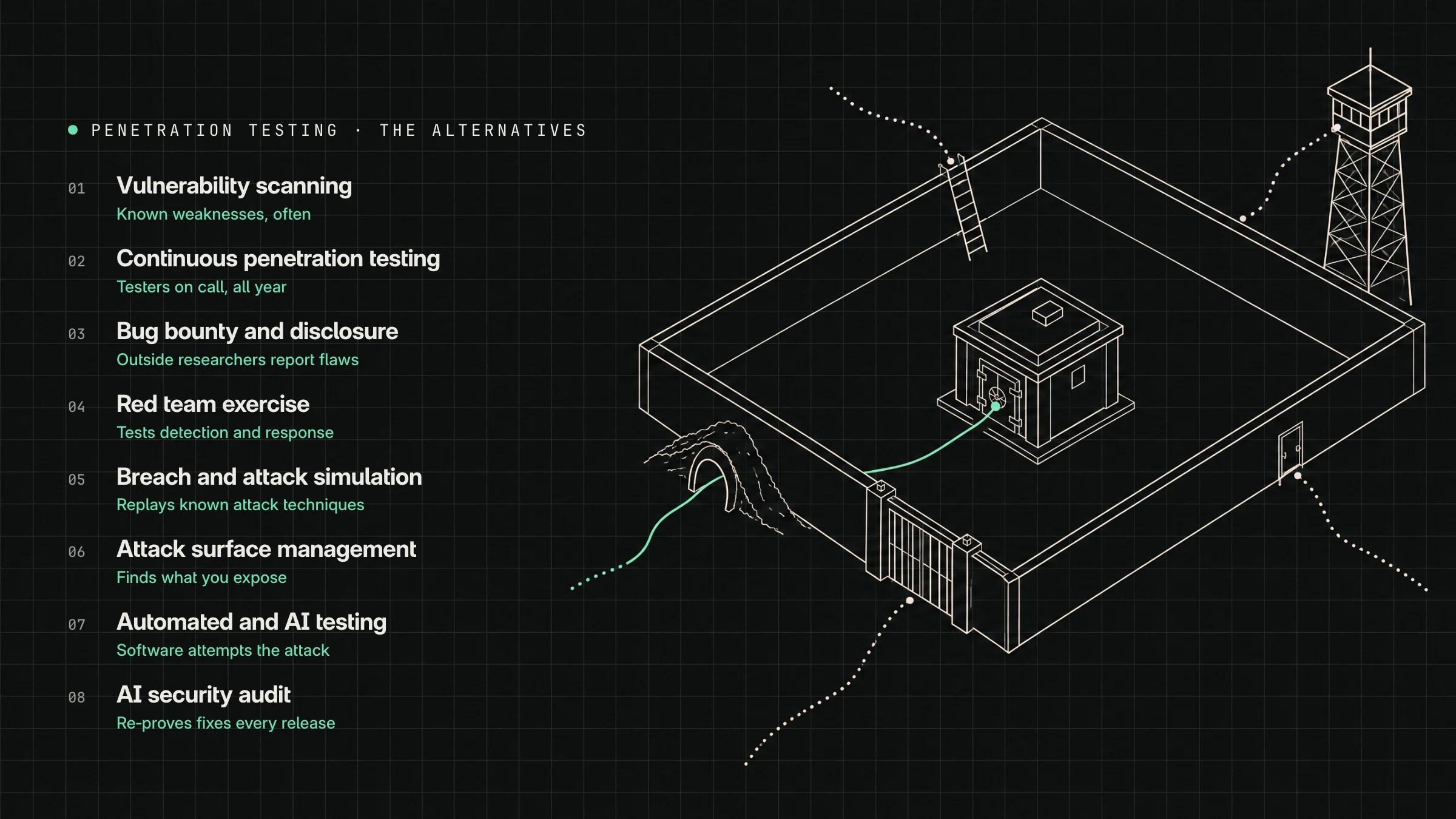
There are eight main alternatives to penetration testing: vulnerability scanning, continuous penetration testing as a service, bug bounty and vulnerability disclosure programmes, red team exercises, breach and attack simulation, attack surface management, automated and AI-driven testing tools, and an AI security audit with continuous re-testing. Most of them work alongside a penetration test. Where a rule such as PCI DSS names a penetration test, they add to it; where no rule names one, you can choose by what each covers.
This guide is for a CTO, founder or security lead who has had an annual penetration test, or been asked for one, and wants to know what else exists. What you can use in place of a penetration test depends on who wants the test, and each section below says so.
ExploitOps WeeklyStories like this one, by email every Friday.Subscribe
Definitions come from NIST, the UK’s NCSC, the PCI Security Standards Council, CREST and MITRE where one exists. MATT sells one of the eight, and that section is marked.
Why do teams look for alternatives to a penetration test?
NIST’s technical guide to security testing ↗ describes a penetration test as testers mimicking real attacks to get around a system’s security features. It has a known limit.
The NCSC’s penetration testing guidance ↗ says a test can only show that you were clear of the known issues it looked for “on the day of the test”. CREST’s buyer’s guide ↗ agrees: a test covers only the chosen target, it is a snapshot, and it can miss weaknesses. NIST suggests regular scanning between annual tests.
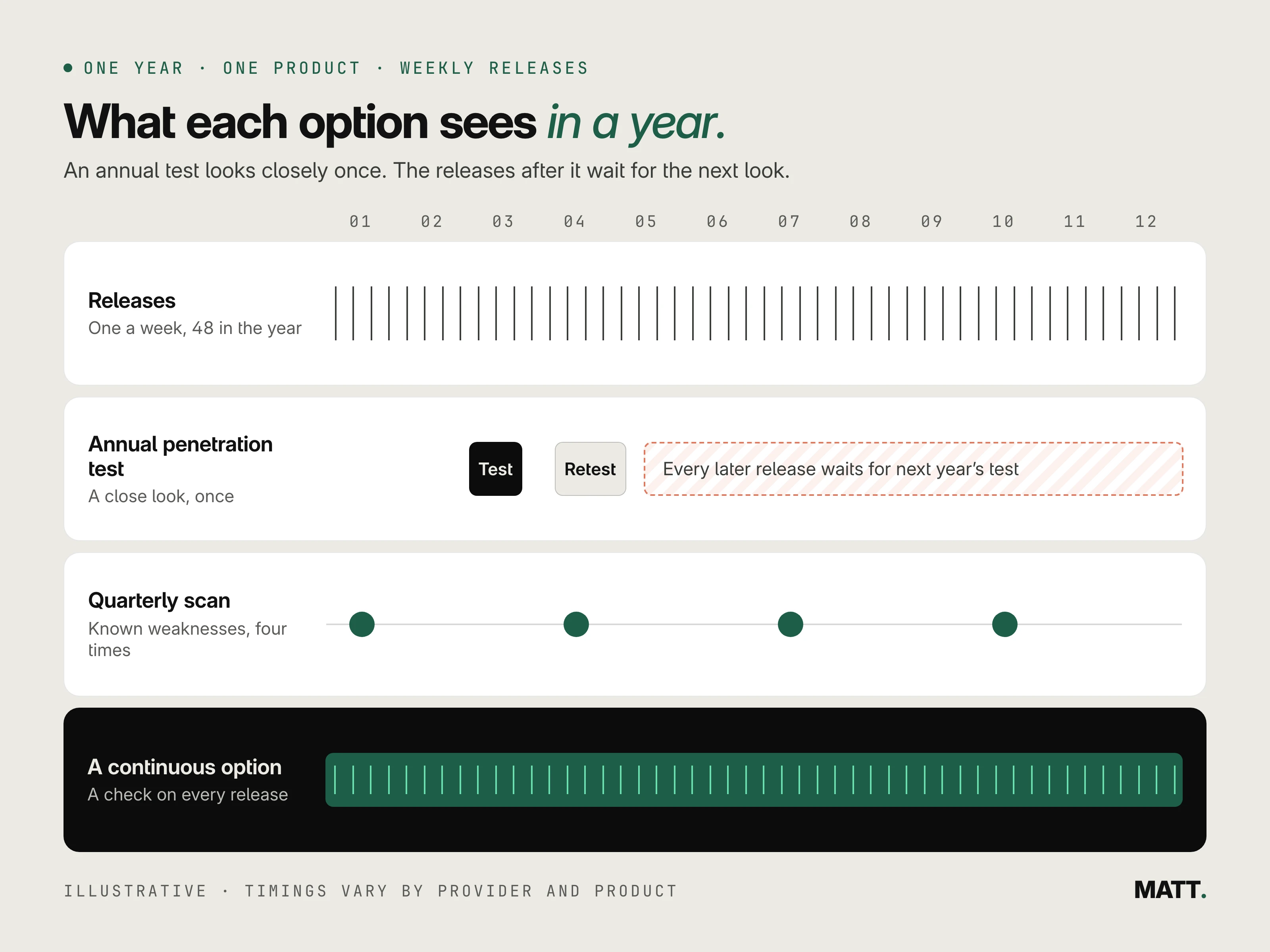
Two things make that snapshot age faster. The first is release speed. A product that ships once a week ships about fifty times between two annual tests.
The second is AI in attackers’ hands. In March 2026 the NCSC and the AI Security Institute wrote ↗ that AI-enabled tools are making vulnerability discovery faster and more comprehensive, and that defenders should assume some attackers already have capable AI tools. At DARPA’s AI Cyber Challenge final ↗ in August 2025, automated systems found 54 of 63 planted vulnerabilities across more than 54 million lines of code, and 18 real ones along the way.
The penetration test keeps its value: skilled people find what tools miss. The practical question is what covers the other fifty weeks.
What are the alternatives to penetration testing?
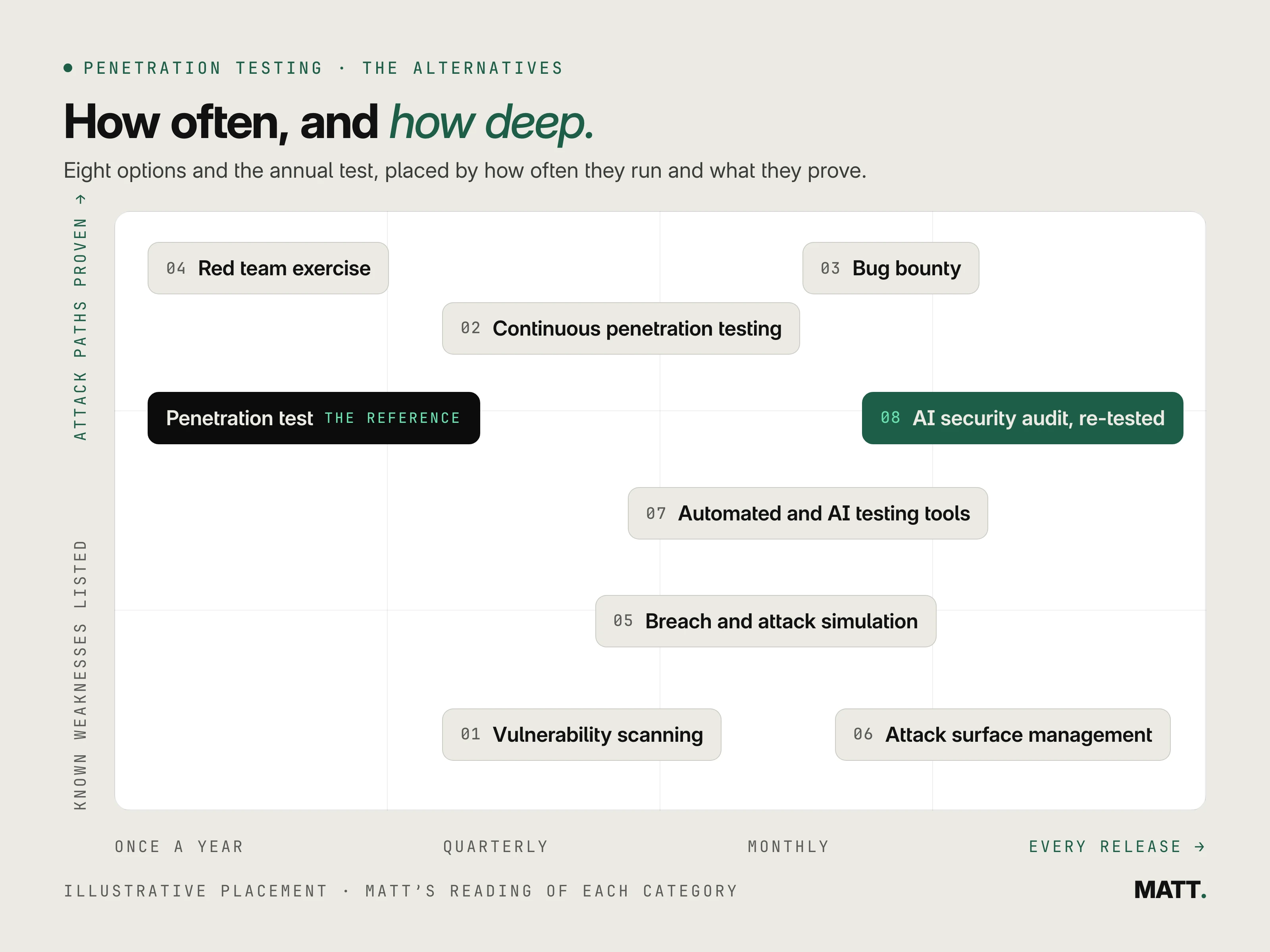
These are the eight pentest alternatives a buyer will meet. The last column answers the auditor’s question.
| Option | What it does | Best for | Counts as a penetration test for a rule? |
|---|---|---|---|
| 1. Vulnerability scanning and assessment | Automated tools find, rank and report known weaknesses | Frequent, broad coverage of known issues | No. PCI DSS asks for scans and a test as separate items |
| 2. Continuous penetration testing (PTaaS) | Human testers, booked through a platform, on demand or all year | Teams that release often | Often yes, with qualified, independent testers. Confirm with your assessor |
| 3. Bug bounty and vulnerability disclosure | Outside researchers report flaws; a bounty pays for valid ones | Mature products with people to triage reports | No. There is no set scope, period or single report |
| 4. Red team exercise | A goal-led attack that emulates a real adversary | Testing how well you detect and respond | A different exercise. DORA asks for a threat-led form |
| 5. Breach and attack simulation | Software replays known attack techniques against your defences | Teams with security controls to tune | No |
| 6. Attack surface management | Finds and monitors what you expose to the internet | Anyone unsure what they expose | No. It feeds the scope of a test |
| 7. Automated and AI testing tools | Software attempts the attack itself | Deeper testing more often, with a person reviewing results | Unsettled. Ask your auditor first |
| 8. AI security audit with re-testing | AI-driven testing that proves each finding and re-runs on every release | Software products that change every week | Ask your auditor. Where a rule names a test, keep it |
1. Vulnerability scanning and assessment
What it is. The PCI Council’s penetration testing guidance ↗ says a vulnerability scan identifies, ranks and reports vulnerabilities, typically with automated tools. CREST describes a vulnerability assessment the same way: tools find known flaws, and nothing is exploited. That is penetration testing vs vulnerability scanning in one line: a scan lists what might be wrong, and a test shows what an attacker can do with it.
What it covers well. Breadth and frequency. The NCSC’s scanning guidance ↗ advises scanning infrastructure at least monthly, and an application whenever it changes.
What it leaves. The same page says automated scanning “cannot compare to manual processes such as penetration testing” for breadth and depth. A scanner has no idea that customer A should never see customer B’s invoices, so flaws in your own logic pass through.
Who it suits, and does it count? It suits everyone, as the floor under every other option. It cannot stand in for a test: the PCI guidance asks for scans at least quarterly and a penetration test at least annually, as separate items.
2. Continuous penetration testing as a service
What it is. People ask “what is continuous penetration testing?” because the term has no official owner. We found no definition from NIST, the NCSC or CREST, so this is general practice. Penetration testing as a service, or PTaaS, delivers human penetration testing through a platform. You scope a test online, and findings appear as testers confirm them. Testing happens on demand, on each major release, or in rolling cycles.
What it covers well. The depth of a penetration test, more often. Findings reach engineers while the code is fresh, and a retest is part of the service.
What it leaves. Depth still depends on who the testers are and how many hours they spend. “Continuous” sometimes means a scanner running all year with a few days of human work on top, so ask for the split.
Who it suits, and does it count? It suits teams that release often. It often counts, since it is a penetration test delivered differently. The PCI guidance looks for a qualified, independent tester and manual work. Ask for a dated report, and confirm with your assessor before you sign.
3. Bug bounty and vulnerability disclosure programmes
What they are. NIST’s glossary defines a bug bounty ↗ as a way of paying people who report software flaws that could be used against security. A vulnerability disclosure programme, or VDP, pays nothing. It tells anyone who finds a flaw where to send it and what to expect. The NCSC’s disclosure toolkit ↗ names three parts: a contact route, a written policy, and a security.txt file on your website. NIST’s SP 800-216 ↗ recommends the same discipline to US federal agencies.
What they cover well. Many researchers with different skills, looking all year. With a bounty you pay for valid results.
What they leave. No one promises to look at any given feature. Every report needs a person to read it, reproduce it and reply.
Who they suit, and do they count? A VDP suits every company with a website. A bounty suits a mature product with people to triage the inbox. Neither gives a defined scope, a set period and one report from named testers, so treat them as an addition to a test.
4. Red team exercises
What it is. NIST’s glossary defines a red team ↗ as a group authorised to emulate a potential adversary’s attack capabilities against an organisation’s security. CREST calls the work adversarial and goal-based: the team gets an objective and takes whatever route works.
What it covers well. Whether your people and monitoring notice a real attack and respond in time.
What it leaves. Coverage. A red team follows one path to its goal and leaves the other flaws unlisted. It also needs a defending team to learn from the result.
Who it suits, and does it count? It suits organisations that already test regularly and have a monitoring team to exercise. It answers a different question from a penetration test. One rule asks for it directly: the EU’s DORA regulation ↗ requires threat-led penetration testing at least every three years for the financial firms that authorities designate.
5. Breach and attack simulation
What it is. We found no standards-body definition we could open and check, so this is general practice. Breach and attack simulation, or BAS, is software that runs known attack techniques against your environment, safely and repeatedly, to check whether your security controls stop or detect them. The techniques are commonly drawn from MITRE ATT&CK ↗, a public knowledge base of adversary tactics and techniques built from real-world observations. MITRE’s open-source Caldera ↗ platform, built on it, is a way to try the idea before buying.
What it covers well. Proof that defences work: whether a technique is blocked, whether an alert fires, whether a configuration change broke something.
What it leaves. It tests defences against known techniques, and finds little in the logic of your own application.
Who it suits, and does it count? It suits companies with a security operations function; an early-stage software company gets little from it. It checks defences you already have, so treat it as an addition to a test.
6. Attack surface management
What it is. NIST defines an attack surface ↗ as the set of points on the boundary of a system where an attacker can try to enter. Attack surface management finds and watches those points. The NCSC’s buyer’s guide to the external kind ↗, published in September 2025, describes it as identifying, monitoring and reducing vulnerabilities in assets that can be reached from the internet.
What it covers well. The things you forgot you had: an old subdomain, a test server left public.
What it leaves. Everything behind a login. The NCSC also cautions that a warning based on a version number means a system is likely affected; confirming it takes more work.
Who it suits, and does it count? It suits companies with many domains, cloud accounts or acquisitions. It is no penetration test; use it to write the scope of one.
7. Automated and AI‑driven penetration testing tools
What they are. Software that attempts the attack itself. Older tools follow scripts. Newer ones, often sold as AI penetration testing, use AI models that plan, try a step and adapt. We found no definition from NIST, CREST or CISA.
What they cover well. Speed, breadth and repetition, as the NCSC post and the DARPA final above both show. One vendor, XBOW, reported in June 2025 ↗ that its autonomous tester reached the top of HackerOne’s US leaderboard after nearly 1,060 submissions. The figure is XBOW’s own, and its post adds that its security team reviewed each finding before submission.
What they leave. Quality varies widely between products. Flaws in business logic need context about roles and customer accounts that the tool must be given. The NCSC post notes that most still stop at finding problems; fixing stays with people.
Who they suit, and do they count? They suit teams that want depth more often than human testers can supply, with someone to review the output. Whether they count is unsettled. The PCI guidance describes a penetration test as a manual process that may include automated tools, so a tool-only report is a weak fit for PCI DSS. For other rules, ask your auditor.
8. An AI security audit with continuous re‑testing
This is the category MATT sells, so read this section as a vendor describing its own product. MATT is an AI security audit: it tests a software product the way an AI-assisted attacker does and re-proves each fix on every release. Teams use it alongside or between annual penetration tests.
What it is. An AI security audit tests your product with AI models working the way an attacker with AI would. Each finding comes with a working attack path as proof, and is written as a plain-English rule with a check, such as “a customer can read only their own invoices”. The checks run again on every release, and each rule is reported as holding or broken.
What it covers well. The logic of a software product that changes often. A fixed flaw that comes back fails its own check on the next release.
What it leaves. Buildings, staff and office networks are outside it. It is a newer category, so fewer auditors have a settled view of it. A rule that holds has held against the attacks that were tried, which is evidence and no guarantee.
Who it suits, and does it count? It suits software companies that release weekly or faster. Ask your auditor whether it counts. Where a rule or a contract names a penetration test, keep the test.
Which rules still require a penetration test?
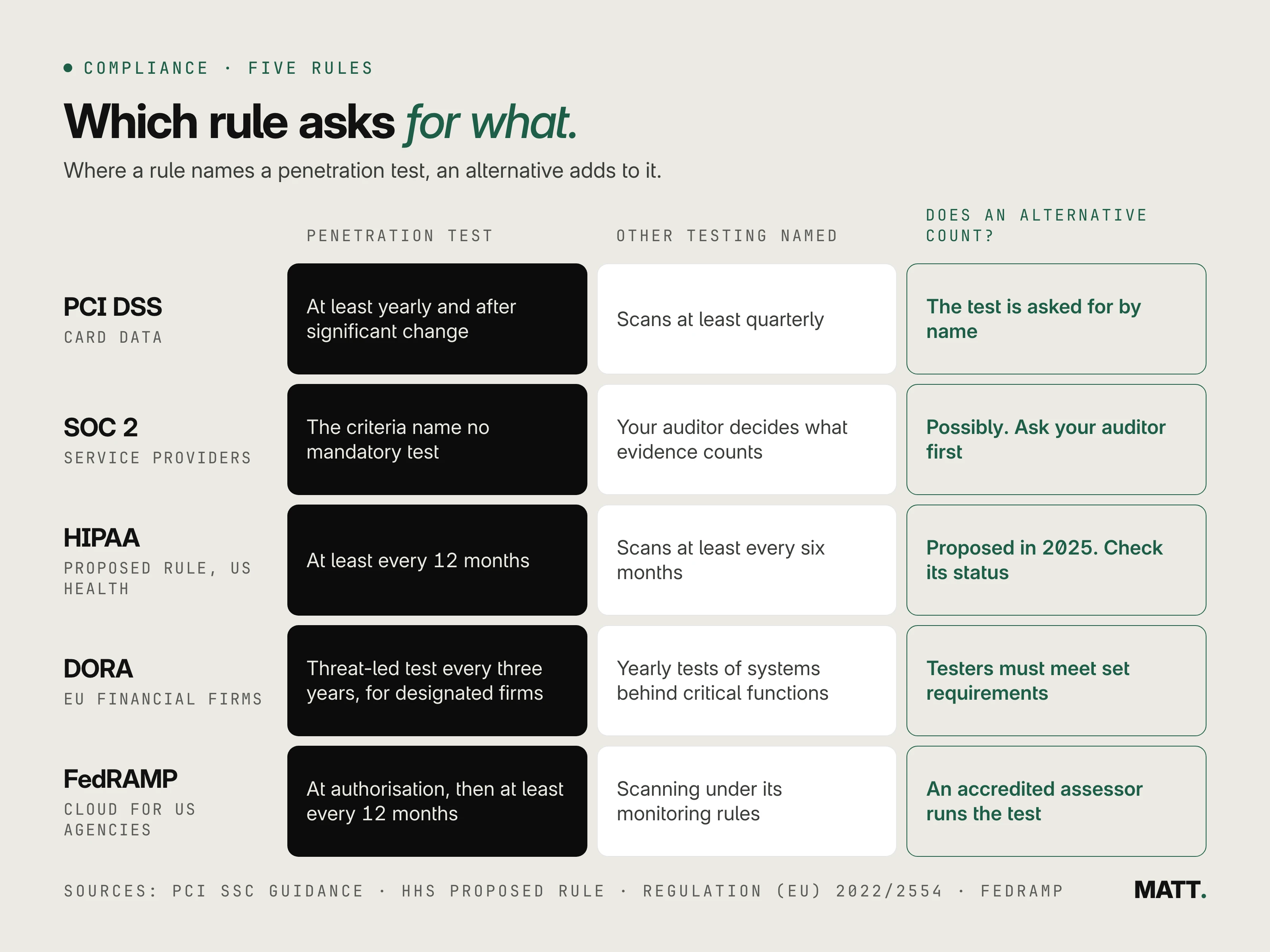
Several do. Check the current text before you rely on this table.
| Rule | What it asks for | Can an alternative stand in? |
|---|---|---|
| PCI DSS | A penetration test at least yearly and after significant change, by a qualified, independent tester, plus vulnerability scans at least quarterly (Council’s guidance ↗) | No. The scan and the test are separate items, and the test is named |
| SOC 2 | The criteria name no mandatory penetration test. Many auditors expect one as evidence | Possibly. Ask your auditor what they will accept before you buy |
| HIPAA | A rule proposed in January 2025 ↗ would require a penetration test at least every 12 months and vulnerability scans at least every six | It is a proposal. Check its current status |
| DORA | Threat-led penetration testing ↗ at least every three years for designated firms, and yearly testing of systems behind critical functions | Testers must meet the regulation’s own requirements |
| FedRAMP | A penetration test by an accredited assessor ↗ at authorisation and at least every 12 months after | No. The assessor runs the test |
A customer contract is a rule too: if it says “annual third-party penetration test”, that is what the customer will ask to see.
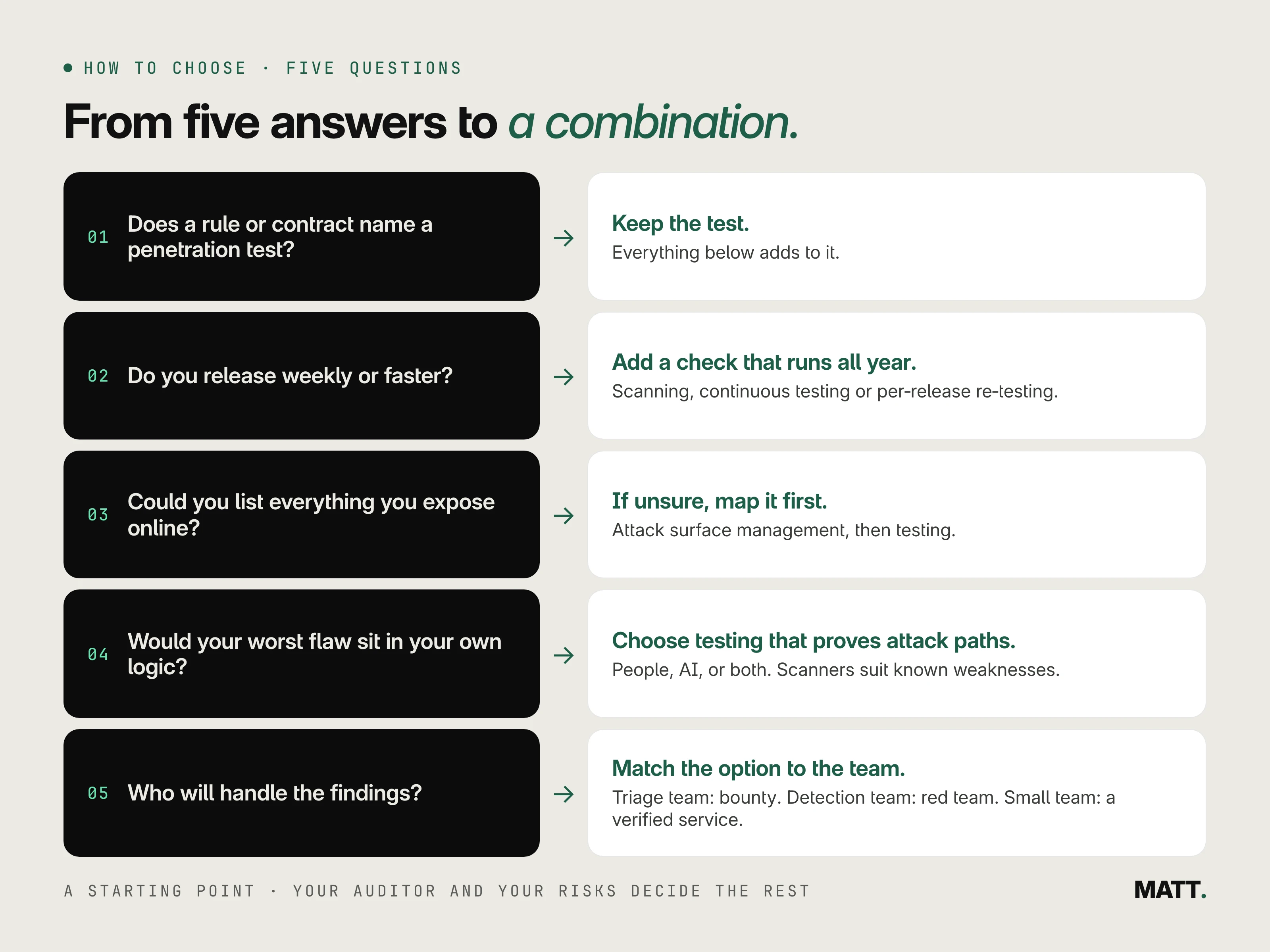
How to choose: five questions
- →1. Does a rule or a contract name a penetration test? If yes, keep the test. Everything else on this page adds to it.
- →2. How often do you release? If weekly or faster, add a check that runs all year: scanning at the least, and continuous testing or per-release re-testing for depth.
- →3. Can you list everything you expose to the internet? If you are unsure, start with attack surface management, then test what it finds.
- →4. Where would your worst flaw sit? Scanning finds known weaknesses in software you run. For your own logic, such as who can see whose data, choose testing that proves attack paths: people, AI, or both.
- →5. Who will handle the findings? A team that can triage reports can run a bug bounty. A team that watches for attacks can use a red team or attack simulation. A small team needs an option that verifies each finding first.
Sensible combinations for three example companies
These three are illustrative. Your own risks and rules will move the details.
| Example company | A sensible combination | Why |
|---|---|---|
| Early-stage SaaS: ten engineers, weekly releases, no compliance rule yet | A disclosure policy and security.txt. Scanning in the build pipeline. One deep test before the first enterprise deal, with the fixes re-tested | Proof for the first customer who asks |
| Selling to enterprises, with SOC 2 | An annual penetration test, since customers ask for it by name. Monthly scanning. One continuous option between tests: PTaaS, or an AI security audit with re-testing | The test answers the questionnaire. The rest covers the releases in between |
| Handling card data under PCI DSS | The penetration tests and quarterly scans that PCI DSS asks for. Then a continuous option for the product, and a bug bounty once the basics are clean | The rule sets the floor |
Questions to ask any provider of an alternative
For a penetration test itself, the buyer’s guide has twelve more.
- →Who or what does the testing? Ask for the split between people, scripted tools and AI, in hours.
- →Does each finding come with proof? Steps to reproduce, and evidence that it worked.
- →What do you test behind the login? Which roles, and how many separate customer accounts.
- →How often does it run? On a date, on a release, or on request.
- →What happens after we fix something? Whether a retest is included, and how soon.
- →What can it do in production, and where does our data go?
- →What will my auditor receive? A dated report with scope, method and named testers, and whether an assessor has accepted it for your rule.
- →What does this leave out? A good provider answers this one plainly.
Where MATT fits
MATT is option eight, one choice among several. It is an alternative to relying on the annual test alone, used alongside a penetration test or between two of them. The audit tests the product and proves each finding. Assurance re-proves each rule on every release. The comparison page sets it next to an annual penetration test.
In one engagement, a MATT scan found 47 exploits, each proved with a working attack path; a penetration test of the same product had reported 3. That is one engagement on one product, and yours will differ.
A penetration test is still what most auditors and card schemes ask for. PCI DSS requires one. SOC 2’s criteria name no mandatory test, so ask your auditor what they will accept. For tools that check code as it is written, see AI code security tools compared.
Sources
- →NIST: SP 800-115 ↗; glossary entries for red team ↗, bug bounty ↗ and attack surface ↗; SP 800-216 ↗, May 2023
- →UK NCSC: Penetration testing ↗; Vulnerability scanning ↗; EASM buyer’s guide ↗, September 2025; Vulnerability disclosure toolkit ↗; frontier AI blog ↗, 30 March 2026
- →PCI Security Standards Council: Penetration Testing Guidance, v1.1 ↗, September 2017
- →CREST: A Guide to Penetration Testing ↗, 2022
- →MITRE: ATT&CK ↗ and Caldera ↗
- →DARPA: AI Cyber Challenge results ↗, 8 August 2025
- →XBOW: its account of its HackerOne ranking ↗, 24 June 2025 (self-reported)
- →US Department of Health and Human Services: HIPAA Security Rule, proposed rule ↗, 6 January 2025
- →European Union: Regulation (EU) 2022/2554 (DORA) ↗
- →FedRAMP: Penetration Test Guidance, v3.0 ↗, June 2022
Product and company names belong to their owners and are named for identification; no affiliation is implied.
Questions
Is there an alternative to penetration testing?
Yes, eight main ones: vulnerability scanning, continuous penetration testing as a service, bug bounty and disclosure programmes, red team exercises, breach and attack simulation, attack surface management, automated and AI testing tools, and an AI security audit with re-testing. Most work alongside a test.
Can a vulnerability scan replace a penetration test?
No. A scan lists known weaknesses with automated tools; a penetration test has people exploit weaknesses to show what an attacker can reach. PCI DSS asks for both: scans at least quarterly and a test at least yearly.
Does SOC 2 accept an alternative to a penetration test?
SOC 2’s criteria name no mandatory penetration test, so the decision sits with your auditor. Many expect a test as evidence. Ask yours what they will accept before you buy.
What is continuous penetration testing?
It is human penetration testing delivered through a platform, on demand or through the year, often called PTaaS. No standards body defines the term. Ask any provider how many hours of human testing you get, and for a dated report.
Can AI tools do a penetration test?
AI tools can find and exploit real flaws quickly, as DARPA’s 2025 challenge showed. The PCI Council’s guidance describes a penetration test as a manual process, so ask your auditor before relying on a tool-only report.