Shirudo, explained: what OpenAI and Cisco's Linux shield covers, and what it doesn't
Shirudo puts signed, temporary shields on running Linux systems until the patch lands. What it covers, what it leaves out, and who should try it now.
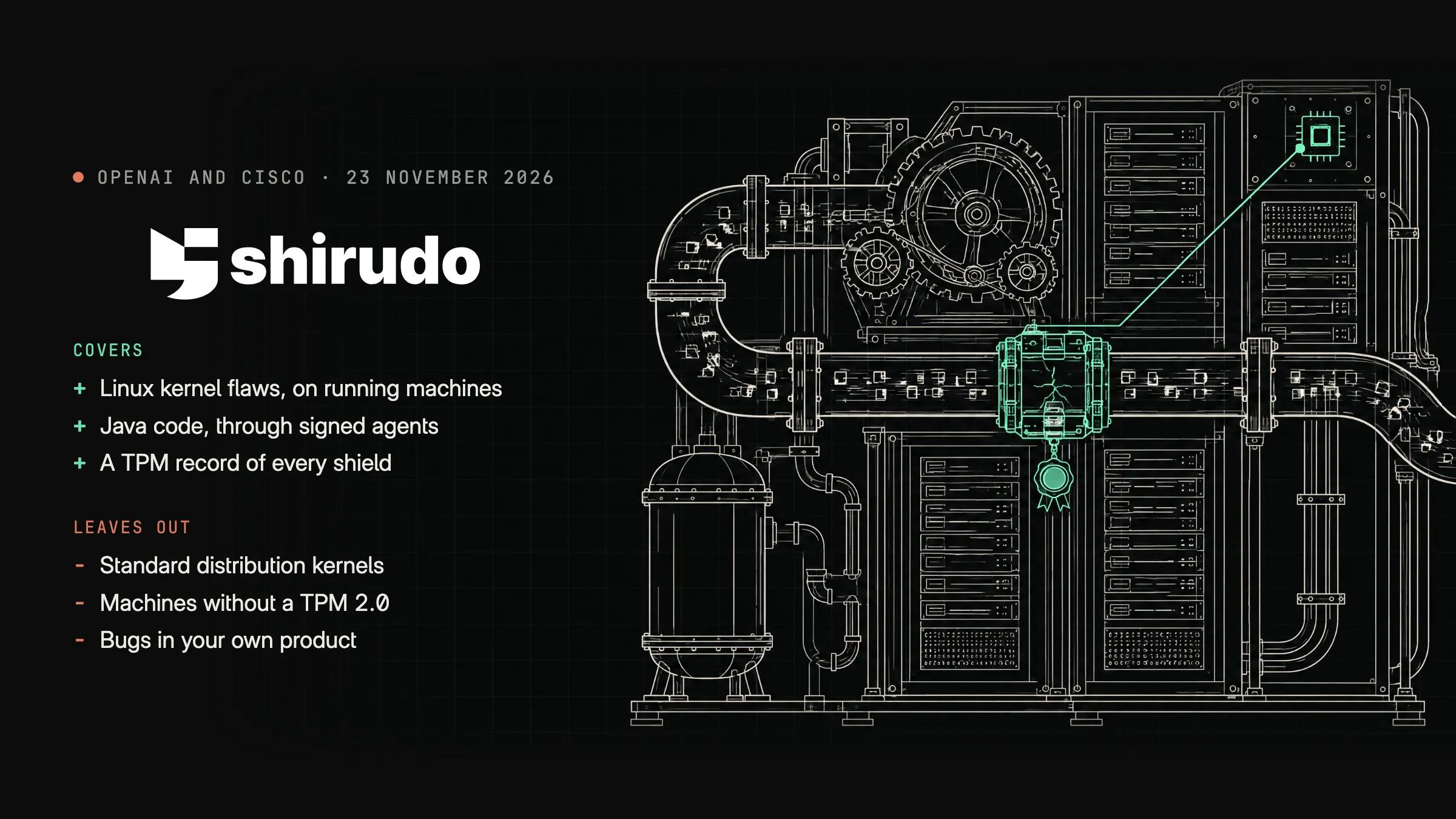
Shirudo is an open-source tool from OpenAI and Cisco, released on 23 November 2026, that puts a small, signed protection called a shield in front of a vulnerable code path on a running Linux machine and keeps it there until the real patch is installed. AI agents such as OpenAI's Codex can write the shields, and an operator approves each one before it loads. It is pre-release, and every machine it protects needs a Linux kernel carrying Shirudo's patches and a TPM 2.0 security chip (OpenAI ↗, Shirudo ↗).
It arrives a week after AI-found flaws hit NGINX, Java and Apache HTTP Server, and its first public demonstration uses one of them: a Codex-written shield blocked a Java4Shell exploit against a running Elasticsearch server. This guide sets out what Shirudo does, what it leaves out, where it helps and where it adds risk, from the two companies' announcements and the project's own documentation.
ExploitOps WeeklyStories like this one, by email every Friday.Subscribe
Why it exists
Testing and deploying a patch can still take days or weeks, OpenAI says, and blocking a risky operation outright can take a service offline, because an exploit and a legitimate request may rely on the same Linux operation. A shield blocks only the behaviour the exploit needs and lets the rest through, and a team can watch its effect on real traffic before switching it on (OpenAI ↗). The pressure comes from attackers' speed: on 13 November Google's Project Zero said it now treats the time between a published patch and a working exploit as zero (Project Zero ↗).
The code comes from Cisco's Isovalent team. Cisco calls Shirudo a rewrite of Tetragon, the eBPF security tool Isovalent open-sourced in 2022 and the base of Cisco's own Live Protect, redesigned for AI agents, which write each protection directly as code (Cisco Isovalent ↗). The project was first presented at the Linux Plumbers Conference in October (LPC ↗).
How a shield gets onto a machine
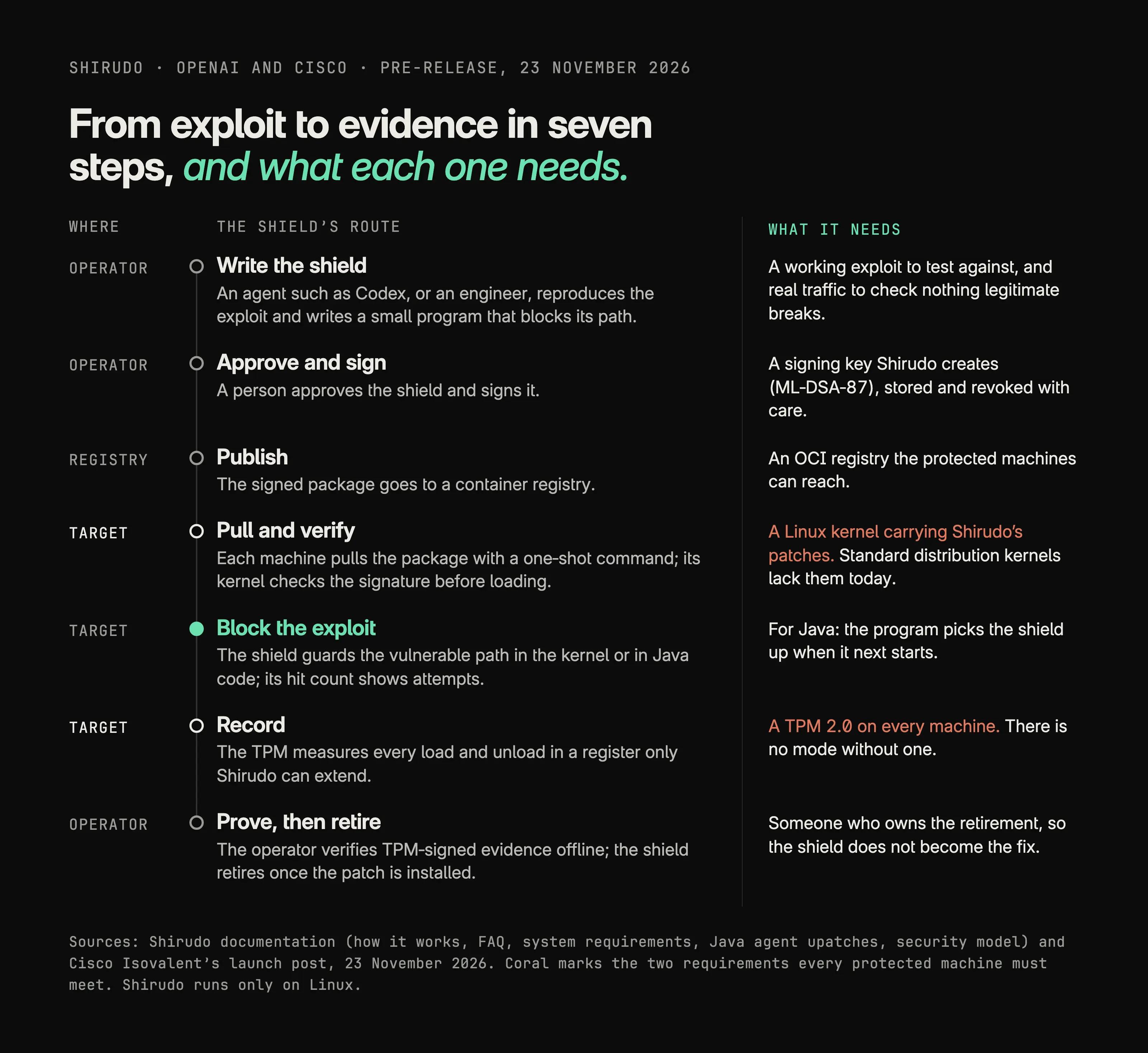
Shirudo is built on eBPF, a Linux feature that runs small, verified programs at chosen points inside the operating system. A shield, which the documentation calls an upatch, is one of those programs or, for Java applications, a small Java agent. Each one takes the same route (Shirudo ↗):
- →Write. An agent or an engineer reproduces the exploit, writes the shield, and tests it against the exploit and against normal traffic. Cisco's demonstration ran this loop in Codex (Cisco Isovalent ↗).
- →Approve and sign. An operator approves the shield and signs it with the team's key. Shirudo signs only with ML-DSA-87, a post-quantum algorithm, using keys it creates itself.
- →Deliver. The protected machine pulls the signed package from a container registry with a one-shot command; nothing on it listens for connections.
- →Load and record. The kernel checks the signature before loading, and the machine's TPM records every load and unload in a register only Shirudo can extend.
- →Prove. The operator asks for TPM-signed evidence and checks offline which shields were running. Once a shield is live, its hit count shows attempts to exploit the flaw it covers.
The Java4Shell demonstration
Cisco's write-up walks through the whole loop. The team fed the Java4Shell disclosure, CVE-2026-114938 in Java's Base64 decoder, into Codex, which produced a shield as Java bytecode that adds a check to the decoder's input. Against Elasticsearch 9.5.5, the shield attached to the decoder, the exploit attempt failed, and Elasticsearch's log recorded the guard rejecting a 65-character input (Cisco Isovalent ↗).
Two details deserve a second look. Help Net Security points out that the people who built the tool also ran the test and set its conditions (Help Net Security ↗). And Shirudo's documentation describes Java shields loading through a setting a Java program reads when it starts, so a program already running keeps the shields it started with until it restarts (Shirudo ↗). The announcement says the demonstration needed no restart; the documented route for a fleet of Java services picks a new shield up at each service's next start.
What Shirudo covers
- →Flaws in the Linux kernel, by blocking the vulnerable path at a kernel hook until the machine runs a kernel with the fix.
- →Flaws in Java code, through signed Java agents that guard the vulnerable method, as in the Java4Shell test.
- →Visibility of process launches, network activity and privilege changes, through an included observation package.
- →Hardening of containers, Kubernetes pods and LLM agents, with policies shipped as shields.
- →Devices with long update cycles, such as embedded and edge hardware, which can take signed mitigations between firmware updates.
- →Evidence: a TPM-signed record of which protections were loaded and when, which an auditor can check offline (Shirudo on GitHub ↗).
What it leaves out
| Gap | What the project says | What it means today |
|---|---|---|
| Standard Linux kernels | Targets need the signed-loader support from the kernel's BPF development tree plus Shirudo's kernel patches (Shirudo ↗) | A protected machine runs Shirudo's kernel build or one you patch yourself |
| Machines without a TPM 2.0 | Every target needs one; there is no mode without it (Shirudo ↗) | Older servers, and virtual machines without a virtual TPM, are out |
| Existing eBPF tools | Cilium, Falco and bpftrace fail on a target as they are; their logic can ship as signed shields | Teams already running eBPF for security or networking face a migration |
| Java programs already running | A running JVM keeps the agents it started with until it restarts (Shirudo ↗) | Java shields need a restart window in normal operation |
| An attacker inside the kernel | A kernel exploit, or a module signed with a key the kernel trusts, goes around every check | It defends against root without the signing key, a different adversary |
| Production use | Pre-release, with no stable releases or supported branches | A project for a lab and for contributors, for now |
| Other operating systems | Shirudo runs only on Linux | Windows and macOS servers are out of scope |
It also has nothing to say about flaws that live in a company's own product: a missing check on an API, one customer able to read another's records, a key left with a former vendor. A shield blocks a known path in shared software. The rules for who can do what inside a product still have to be written down and tested by the people who build it.
Where it helps
- →It covers the dangerous stretch. The days between a fix's release and its arrival on every machine are when attackers now strike; a tested shield can protect a service through them.
- →Shields could ship with disclosures. OpenAI says the goal is to publish tested shields alongside vulnerability disclosures, so operators can evaluate and deploy them while preparing the patch (OpenAI ↗).
- →It leaves a record. Every load and unload is measured in the TPM, so a team can show an auditor or a customer which protections were in place on a given day.
- →It is open. The code is BSD 2-Clause, with its BPF programs dual-licensed under BSD and GPL, so anyone can read a shield before trusting it; the repository passed 1,000 stars within a day of the launch (GitHub ↗).
- →A person still decides. Agents propose shields; operators approve and sign them.
Where it can hurt
- →The setup is heavy. A patched kernel and a TPM-measured boot are serious platform work. The most upvoted reply on Hacker News made the point that this is a measured-boot project, far from a patch you deploy in an emergency (Hacker News ↗).
- →Shields can become permanent. Commenters compared shields to web application firewall rules, which pile up and quietly stand in for the fixes they were meant to bridge. Cisco says a shield retires when the real patch lands; that happens only if someone owns the retirement.
- →A wrong shield blocks customers. The design exists because legitimate requests and exploits can share an operation, so a shield that misjudges the difference takes a service down. Testing against real traffic is the safeguard, every time.
- →The signing key becomes critical. The security model notes that any artifact the key ever signed will load, so key storage, rotation and revocation need the same care as the shields (Shirudo ↗).
- →There are more moving parts. A registry, a signing pipeline, an agent loop and attestation checks are new systems to run and secure.
Who should try it now
Platform teams that already build their own Linux kernels, run machines with a TPM 2.0 and have engineers who can review a shield should start with the VM quickstart, which uses a software TPM, and Isovalent's self-guided lab (Shirudo quickstart ↗, Isovalent lab ↗). OpenAI and Cisco hold a technical webinar on 15 December. Everyone else should watch whether mainstream Linux distributions take up the kernel changes, and keep their own patch clock short in the meantime. To see where your own setup stands, the two-minute patch-window check asks six questions and writes three rules to hold until a shield fits.
What to check this week
- →Measure your patch window. For each kind of system, count the days from a security release to its arrival in production. That number is the stretch a shield would have to cover.
- →List the candidates. Linux machines whose kernel you build or choose, with a TPM 2.0, running services you cannot restart at short notice. That list is where Shirudo could apply first.
- →Try it in a lab, away from production. The quickstart runs in a virtual machine with a software TPM, which is the safe way to learn what a shield involves.
- →Name who approves and who retires. Decide who signs a shield and which event removes it, before the first one is needed.
- →Keep the basics moving. Patching, least privilege and secret hygiene cover everything shields leave out.
Written down as rules a team can test on every release, those checks read: every shield has an owner and an expiry tied to its patch; no shield outlives the deployment of its fix; every internet-facing service gets each security release within an agreed number of days, shield or no shield. On any given day each rule holds or breaks, and the answer can be checked.
What we don't know
- →How it behaves across a fleet. The project publishes overhead and scaling figures for a single machine; we found no independent measurements at scale.
- →Whether Linux distributions adopt the kernel changes. Until they do, Shirudo depends on its own kernel build.
- →How often shields will ship with disclosures. OpenAI states it as a goal; the one public shield so far, for Java4Shell, came six days after the flaw was disclosed.
- →Whether a managed version is coming. Neither company has said whether it will offer one.
Sources
- →OpenAI, OpenAI and Cisco introduce Shirudo ↗, 23 November 2026
- →Cisco Isovalent, Cisco and OpenAI introduce Shirudo ↗, 23 November 2026
- →Shirudo, code on GitHub ↗ and documentation ↗: FAQ ↗, system requirements ↗, Java agent upatches ↗, security model ↗
- →Linux Plumbers Conference, shirudo: BPF live-patching infra for the agentic era ↗, October 2026
- →Help Net Security, Linux patches can take weeks, and OpenAI and Cisco built Shirudo to help in the meantime ↗, 24 November 2026
- →Hacker News, discussion of the launch ↗, 23 November 2026
- →Google Project Zero, Policy and Disclosure: 2026 Edition ↗, 13 November 2026
Company logos identify the organisations named in public statements and imply no affiliation with MATT.
Questions
What is Shirudo?
Shirudo is an open-source runtime from OpenAI and Cisco, released on 23 November 2026, that loads small signed protections, called shields, into running Linux systems to block a vulnerable code path until the real patch is installed. It uses eBPF in the kernel and signed Java agents for Java code, and records every change in the machine's TPM.
Does Shirudo replace patching?
No. Its own documentation says a shield covers the time until the machine runs a kernel or runtime with the fix. The intended lifecycle is shield, patch, then retire the shield.
Can I run Shirudo on my Linux servers today?
Only in a lab for most teams. Shirudo is pre-release, and every protected machine needs a kernel with the BPF development tree's signed-loader support and Shirudo's patches, plus a TPM 2.0. The VM quickstart lets you try it with a software TPM.
Does Shirudo protect Java applications?
Yes, through signed Java agents. In Cisco's test a Codex-written shield blocked a Java4Shell exploit against Elasticsearch 9.5.5. The documentation says a running Java program picks up new agents when it restarts.
How is Shirudo related to Tetragon?
Cisco describes Shirudo as a rewrite of Tetragon, the eBPF security tool Isovalent open-sourced in 2022, redesigned so that AI agents can write protections directly as code.
Is Shirudo open source?
Yes. The code is under the BSD 2-Clause licence, with its BPF programs dual-licensed under BSD and GPL, on GitHub at shirudo-dev/shirudo.