Outlook CVE‑2026‑124194: credited to Claude, exploited before the fix
An Outlook flaw credited to a researcher using Claude was exploited before Microsoft's 10 November fix. How the NTLM hash leak works, and what to check now.
CVE-2026-124194 is a flaw in Microsoft Outlook that attackers were already exploiting when Microsoft fixed it on 10 November 2026: a crafted message file, once opened, makes Outlook connect to the attacker's server without its usual warning and hand over the user's NTLMv2 hash, which can be used to sign in as that user. Microsoft credits the find to Benoit Sevens, "using Claude with Anthropic", and to a second researcher, nono (Microsoft ↗).
The US Cybersecurity and Infrastructure Security Agency (CISA) added it to its Known Exploited Vulnerabilities catalogue the same day and gave federal agencies until 24 November to fix it (CISA ↗). It is the only flaw in Microsoft's November release marked as exploited.
How the leak works
Windows networks still use NTLM, an old way for a computer to prove who its user is. When a Windows program reaches for a file on a network server, Windows can answer that server automatically with a value derived from the user's password, the NTLM hash. Outlook normally warns before it fetches anything from outside; this flaw skips the warning. Microsoft's advisory describes the attack in four steps:
- →The file. An attacker who needs no account sends a specially crafted message file and convinces the user to open it in Outlook.
- →The connection. Opening it makes Outlook connect to a network location the attacker controls, without the usual external-content warning.
- →The leak. The connection discloses the user's NTLMv2 hash, which Microsoft says the attacker could use to authenticate as the user.
- →The limit. The Preview Pane is no route in, Microsoft says: the user has to open the file.
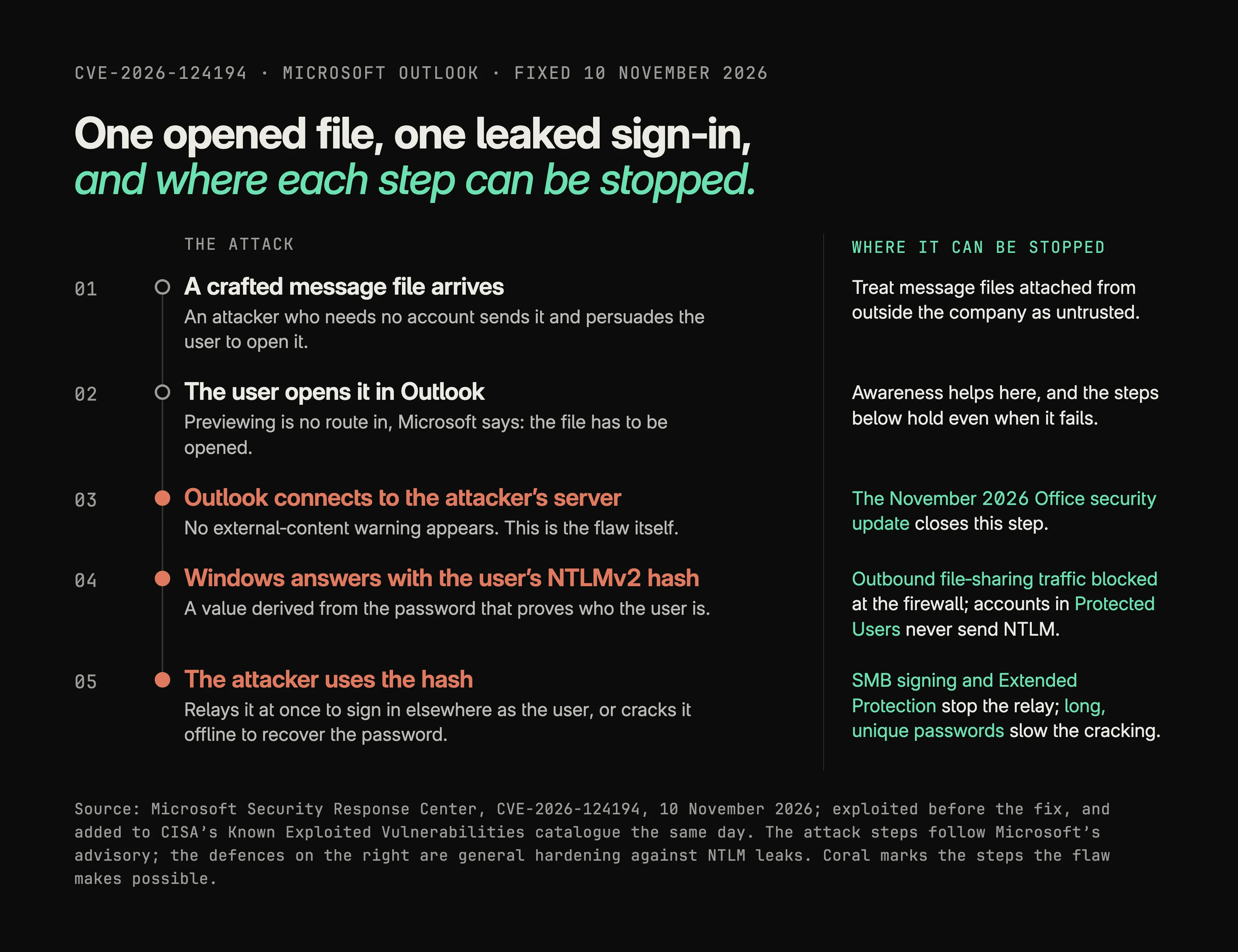
With a hash in hand, an attacker has two common uses for it: relay it at once to another server that accepts NTLM and sign in there as the user, or try to crack it offline to recover the password. Microsoft rates the flaw Moderate, 6.5 out of 10; the score assumes someone has to open a file. A convincing email has always been able to arrange that.
Where the AI fits
Microsoft's acknowledgement names Benoit Sevens "using Claude with Anthropic". It is the only credit in Microsoft's November release that names Claude as the tool; four Hyper-V flaws in the same release credit Xinyang Ge, also with Anthropic, without naming a tool. Microsoft does not say how Claude was used, whether the flaw was found by examining an attack already under way, or how long attackers had it before the fix. We found no public statement from Anthropic about the finding.
This year models have found flaws that were reported and fixed before any known attack, in Firefox and in Brotli. Here a model-assisted find and an attack in progress met in the same fix. And once a fix is out, Google has now reported an AI system that reads each new security fix and writes the attack. Either way, the clock that matters starts when the fix is published.
The 2023 precedent
Outlook has leaked NTLM sign-ins before. In March 2023 Microsoft fixed CVE-2023-23397, which a message with a crafted reminder property triggered on its own, with no user interaction. Microsoft said a Russia-based threat actor had used it in targeted attacks on organisations in government, transportation, energy and the military in Europe (Microsoft, 2023 ↗). The 2026 flaw needs the file opened; the prize, a reusable sign-in, is the same.
Microsoft deprecated every version of NTLM in June 2024 and recommends Negotiate, which prefers Kerberos, in its place (Microsoft ↗). Deprecated still means present: NTLMv2 ships in current Windows, and both Outlook flaws relied on it.
What to check this week
- →Update Office wherever Outlook runs. Microsoft lists Microsoft 365 Apps for Enterprise and Office LTSC 2021 and 2024 as affected. The fixed builds are 16.0.14334.21048 for LTSC 2021 and 16.0.17932.21140 for LTSC 2024; Microsoft 365 Apps take the November security update on each update channel (Microsoft ↗). Machines that sit on a deferred channel or rarely restart Office are the ones to chase.
- →Stop file-sharing traffic leaving the network. A workstation rarely needs to reach a file share on the internet. Blocking outbound SMB (port 445) at the firewall stops the most common way a leaked hash leaves the building.
- →Keep NTLM away from the accounts that matter. Members of Windows' Protected Users group cannot authenticate with NTLM at all (Microsoft ↗). Add administrators and other privileged accounts first, and test, because older applications that depend on NTLM stop working for them.
- →Make a relayed hash worth less. SMB signing and Extended Protection for Authentication on servers that accept NTLM block the relay; long, unique passwords slow the cracking.
- →Look for the signs. Connections from Outlook to unfamiliar outside servers, NTLM sign-ins from places a user has never signed in from, and message files arriving as attachments from outside the company.
Written down as rules a team can test on every release, those checks read like this: no workstation opens a file-sharing connection to the internet; no privileged account signs in with NTLM; every machine running Outlook carries the latest security update within an agreed number of days of its release.
What we don't know
- →Who exploited it, and against whom. Microsoft names no attacker, target or number of victims.
- →How Claude was used. The acknowledgement names the tool and nothing more.
- →Which came first. Whether the flaw was found from an attack or found independently and exploited by others has not been published.
- →How long the window was. Microsoft has not said when exploitation began.
Sources
- →Microsoft Security Response Center, CVE-2026-124194: Microsoft Outlook Spoofing Vulnerability ↗, 10 November 2026
- →Microsoft Security Response Center, November 2026 Security Updates ↗, 10 November 2026
- →CISA, Known Exploited Vulnerabilities catalogue: CVE-2026-124194 ↗, added 10 November 2026
- →Microsoft Security Response Center, Microsoft Mitigates Outlook Elevation of Privilege Vulnerability ↗, 14 March 2023
- →Microsoft, Deprecated features in the Windows client ↗ and Protected Users security group ↗
Questions
What is CVE‑2026‑124194?
A flaw in Microsoft Outlook, fixed on 10 November 2026. A specially crafted message file, once opened, makes Outlook connect to an attacker's server without its usual warning, disclosing the user's NTLMv2 hash, which can be used to sign in as that user.
Is CVE‑2026‑124194 being exploited?
Yes. Microsoft marked it as exploited when it released the fix, and CISA added it to its Known Exploited Vulnerabilities catalogue the same day, with a 24 November deadline for US federal agencies.
Does previewing the email trigger it?
No. Microsoft says the Preview Pane is no route in; the user has to open the crafted file in Outlook.
Did an AI find the Outlook flaw?
Microsoft credits Benoit Sevens "using Claude with Anthropic" and a second researcher, nono. Neither Microsoft nor Anthropic has published how Claude was used or whether the flaw was found from an attack already under way.
What should a company do now?
Install the November 2026 Office security update on every machine running Outlook, block outbound SMB at the firewall, put privileged accounts in the Protected Users group, and watch for Outlook connecting to unfamiliar outside servers.