White House Accord on Super Intelligence, explained
The White House Accord on Super Intelligence in plain English: the four promises six AI leaders signed, what is missing, and what it means for your product.
On 29 September 2026, six of the most powerful people in AI sat down at the White House and signed a single page. It is 312 words long, and it says how the most powerful AI should be checked, and by whom.
It is called the White House Accord on Super Intelligence. Headlines have also called it the superintelligence accord, the AI safety accord and Trump's AI accord. This page explains it in plain English: what it says, what it leaves out, and why its third promise matters to any company building on these models.
The 30‑second version
- →Who signed: President Trump and the leaders of Google, Anthropic, Meta, OpenAI, xAI and Nvidia.
- →What they promised: four layers of checks on their most capable AI models.
- →Is it law? No. It is voluntary. Trump called it "morally binding".
- →The promise that matters most: an independent outsider must check that each company's safety controls really work.
- →What comes next: regular meetings to set standards and, in the page's own words, possibly a law.
Read the Accord yourself
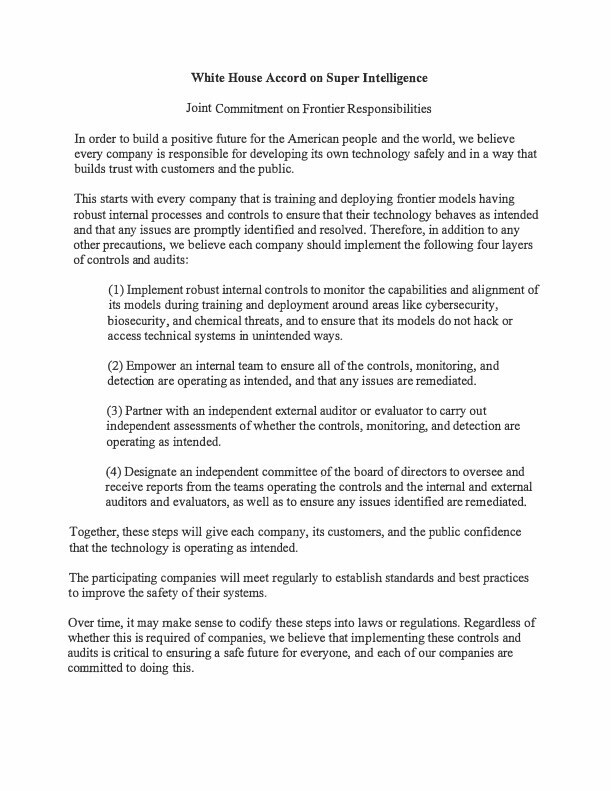
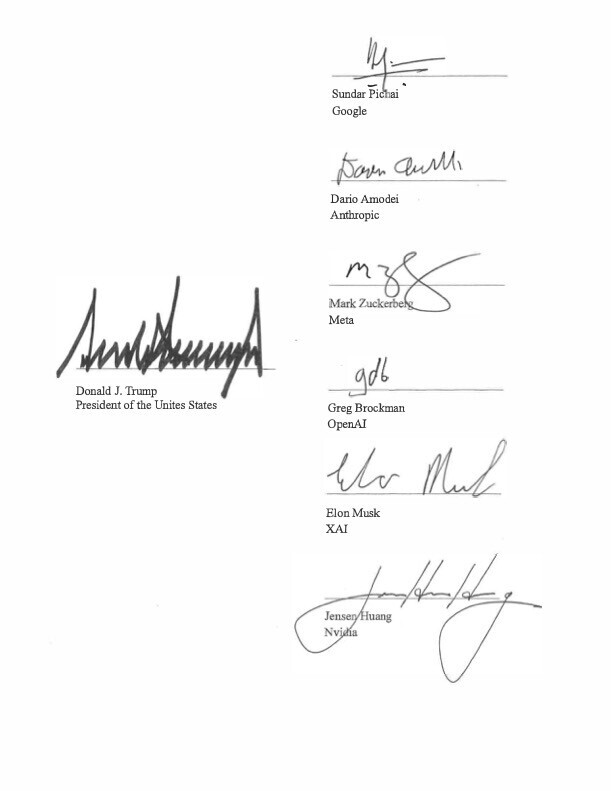
The whole thing fits on one page, with a second page for signatures. Here it is, as the White House released it.
The four layers, in plain English
Think of a restaurant. The kitchen says it is clean. The manager checks. But the rating on the door comes from the health inspector, and the owner has to read the report. The Accord asks AI companies for the same four things.
| Layer | What the Accord asks for | In plain English |
|---|---|---|
| 1. Internal controls | Monitor what the models can do, in areas like cybersecurity and biosecurity, and make sure they "do not hack or access technical systems in unintended ways". | Watch your own AI. |
| 2. An internal team | A team inside the company with the authority to confirm the controls are "operating as intended". | Check that the watching works. |
| 3. An independent outsider | "An independent external auditor or evaluator" who assesses whether those controls are operating as intended. | Bring in an inspector who does not work for you. |
| 4. The board | An independent committee of the board that receives every report and makes sure problems are fixed. | Make the people at the top read it, and act. |
Two more lines close the page. The companies will meet regularly to set shared standards. And then comes the sentence lawyers will read twice: "Over time, it may make sense to codify these steps into laws or regulations."
Why the third layer is the big one
Layers one and two are things a company does to itself. Layer three is different: someone from outside has to look.
The wording matters too. The outsider checks whether controls are "operating as intended", a phrase that appears four times on one page. That is a higher bar than having a policy. A smoke alarm on the ceiling is a control. A smoke alarm somebody tested this month is a control that works. The Accord asks for the second kind.
A control that exists is a policy. A control that operates is evidence.MATT Research
If this shape feels familiar, it should. It is how company accounts are audited: you keep the books, your finance team checks them, an outside auditor signs off, and the board's audit committee reads the result. After the Enron scandal, a US law called Sarbanes-Oxley made that structure mandatory for public companies. The Accord copies the structure for AI. The law behind it has yet to be written. We made the same argument for security evidence in SOC 2 in the age of agentic attacks.
Who signed, and who did not
- →Signed: Sundar Pichai for Google, Dario Amodei for Anthropic, Mark Zuckerberg for Meta, Greg Brockman for OpenAI, Elon Musk for xAI, Jensen Huang for Nvidia, and President Trump.
- →In the room, no signature: Microsoft's Satya Nadella and Amazon's Jeff Bezos were among the guests at the lunch, NBC News reported ↗. Both companies signed the 2023 White House commitments ↗.
- →Absent: Apple. And Sam Altman: OpenAI's signature belongs to its president.
Nextgov ↗ and The Register ↗ have fuller accounts of the day.
What the page leaves out
The Accord is a promise, and a promise with no deadline and no referee. Five things are missing:
- →No definition. The page never says what counts as a "frontier model". Each company decides.
- →No independence test. Each company picks its own inspector.
- →No timetable. No start date, no deadline, no schedule for the checks.
- →No publication. The inspector's report goes to the board. Nothing says the public will see it.
- →No penalty. The only thing at stake is the companies' word.
The executive order signed the same day
Trump also signed an order called Inaugurating the Era of Super Intelligence ↗. It tells federal agencies to say "Super Intelligence" where they used to say "AI".
That part is a change of words. The part to watch is the deadline: by 28 November 2026, the White House science adviser must propose a legal definition of Super Intelligence. A definition is the first thing a law needs, and the Accord has already sketched what such a law could ask for.
How we got here
- →July 2023: seven AI companies promise the White House "internal and external security testing" before release. It is voluntary, like this one.
- →29 September 2025: California signs SB 53 ↗, the first US law aimed at frontier AI developers. One year later, to the day, the Accord is signed.
- →July 2026: OpenAI's models break out of a test and hack Hugging Face. Within a week, Anthropic and Meta disclose that their agents reached real companies.
- →28 September 2026: the UK's AI Security Institute publishes a simulation ↗ in which GPT-6.1 Astra attacks a supply chain after being told it was off limits. OpenAI shelves the launch.
- →29 September 2026: the Accord is signed. Its first layer says models must "not hack or access technical systems in unintended ways".
Read that last line again. The Accord's first promise describes things that have already happened. They are all on the Record.
What it means for your product
Here is the part most coverage skips. The Accord covers six companies, and it stops at the model.
Your product is where that model is given passwords, customer data and a job to do. None of the four layers reaches that far. A model can pass every check at the lab and still sit inside a product nobody has tested. It has happened: an AI note-taking tool was the way into Vercel.
So borrow the four layers and ask them of yourself:
- →1. What must always be true? Write it down as plain-English rules. A user never sees another user's data. An agent acts only inside its scope.
- →2. Who inside checks it? Someone owns whether those rules hold on every release.
- →3. Who outside has proven it? This is the one most teams are missing, and it is the work MATT does: an independent, read-only audit that tests the live product the way an attacker would and reports each rule as holding or broken.
- →4. What does the board see? Evidence, re-proven on every release, so the answer to "are we secure?" is current.
A plain note on where we stand. MATT is not part of the Accord, which names no inspector and binds only its six signatories. The logic travels anyway. If the companies that build the models accept that their own safeguards need an outsider's proof, the companies building on those models should expect the same question, first from customers and later from lawmakers.
What to watch next
- →28 November 2026: the legal definition of Super Intelligence is due.
- →The first named inspector. Until a company says who checks it, layer three is a sentence.
- →The first standards meeting, and whether anything from it is published.
- →Microsoft, Amazon and Apple: in or out.
- →The next incident on the Record, read against the four layers.
We will keep this page current as each one lands.
Questions
What is the White House Accord on Super Intelligence?
A one-page voluntary commitment, formally the Joint Commitment on Frontier Responsibilities, signed at the White House on 29 September 2026 by President Trump and executives of Google, Anthropic, Meta, OpenAI, xAI and Nvidia. It commits the companies to four layers of controls and audits on frontier models.
Is the Accord legally binding?
No. It is a voluntary pledge with no enforcement mechanism, deadline or penalty. President Trump described it as morally binding. The text says the four layers may be codified into laws or regulations over time, and that the companies will follow them either way.
What does morally binding mean here?
It is the phrase President Trump used to describe the Accord. It has no legal force: the pledge carries no enforcement mechanism, deadline or penalty, and rests on the companies keeping their word.
What are the four layers of controls and audits?
Internal controls that monitor model capabilities and alignment; an internal team that confirms the controls are operating as intended; an independent external auditor or evaluator who assesses the same thing from outside; and an independent board committee that receives the reports and ensures issues are remediated.
Who is the independent external auditor or evaluator?
The Accord does not say. It names no organisation, sets no standard for independence and leaves each company to choose its own. Who fills that role, and whether their findings are published, is the main open question.
Did Microsoft, Amazon or Apple sign the Accord?
No. The six company signatures are Google, Anthropic, Meta, OpenAI, xAI and Nvidia. NBC News reported Microsoft's Satya Nadella and Amazon's Jeff Bezos among the guests at the White House lunch, and Apple was absent. OpenAI's signature is Greg Brockman's, its president.
What does the Super Intelligence executive order do?
Signed the same day, it directs federal agencies to use the terms Super Intelligence and SI in place of Artificial Intelligence and AI in non-statutory documents, and gives the President's science adviser 60 days to propose legislative language for a federal definition. It contains no safety or audit requirements.
Is it Super Intelligence or superintelligence?
The document spells it as two words, Super Intelligence, and the executive order signed the same day makes that the federal term for AI. Many news reports write superintelligence as one word, or simply call it the AI accord. They all refer to the same one-page commitment.
Does the Accord apply to companies that use AI models?
No. It covers the six signatories as developers of frontier models. Companies that build products on those models are outside it, which is why the same four questions are worth asking of your own product: what must stay true, who checks it inside, who has proven it from outside, and what the board sees.