The $6.3 billion laptop
Binance's first findings trace crypto's largest theft to one laptop. The same week, AI agents broke into Chainalysis. What happened, and what to check.
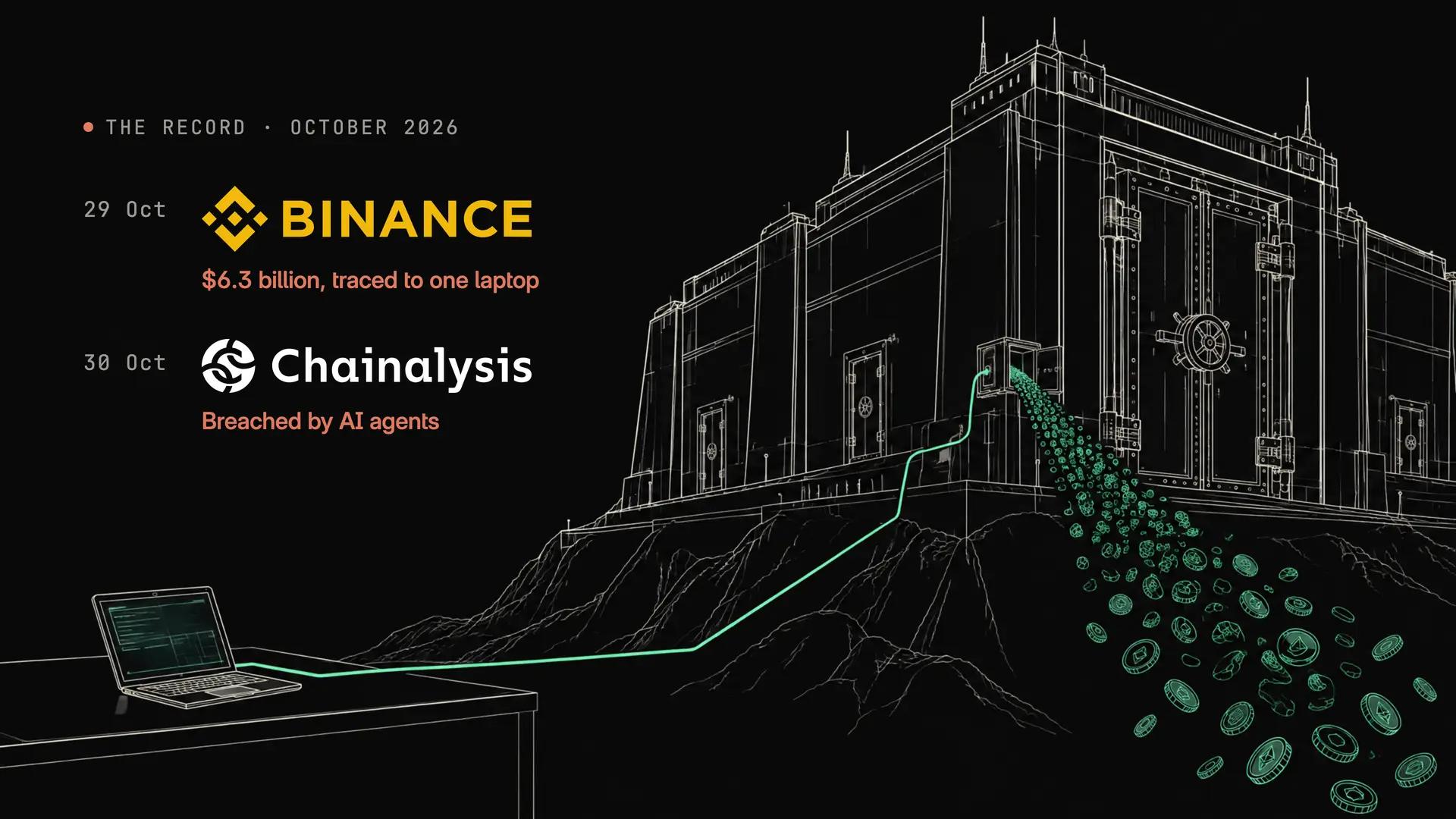
On 29 October 2026 about $6.3 billion left Binance's hot wallets, most of it in about 20 minutes, the largest theft in the history of crypto, and Binance's first findings point to one compromised laptop. The next day  Chainalysis, the blockchain analytics firm helping to trace the money, disclosed that attackers using AI agents had broken into its own systems earlier in the month. Chainalysis says the two incidents are unrelated.
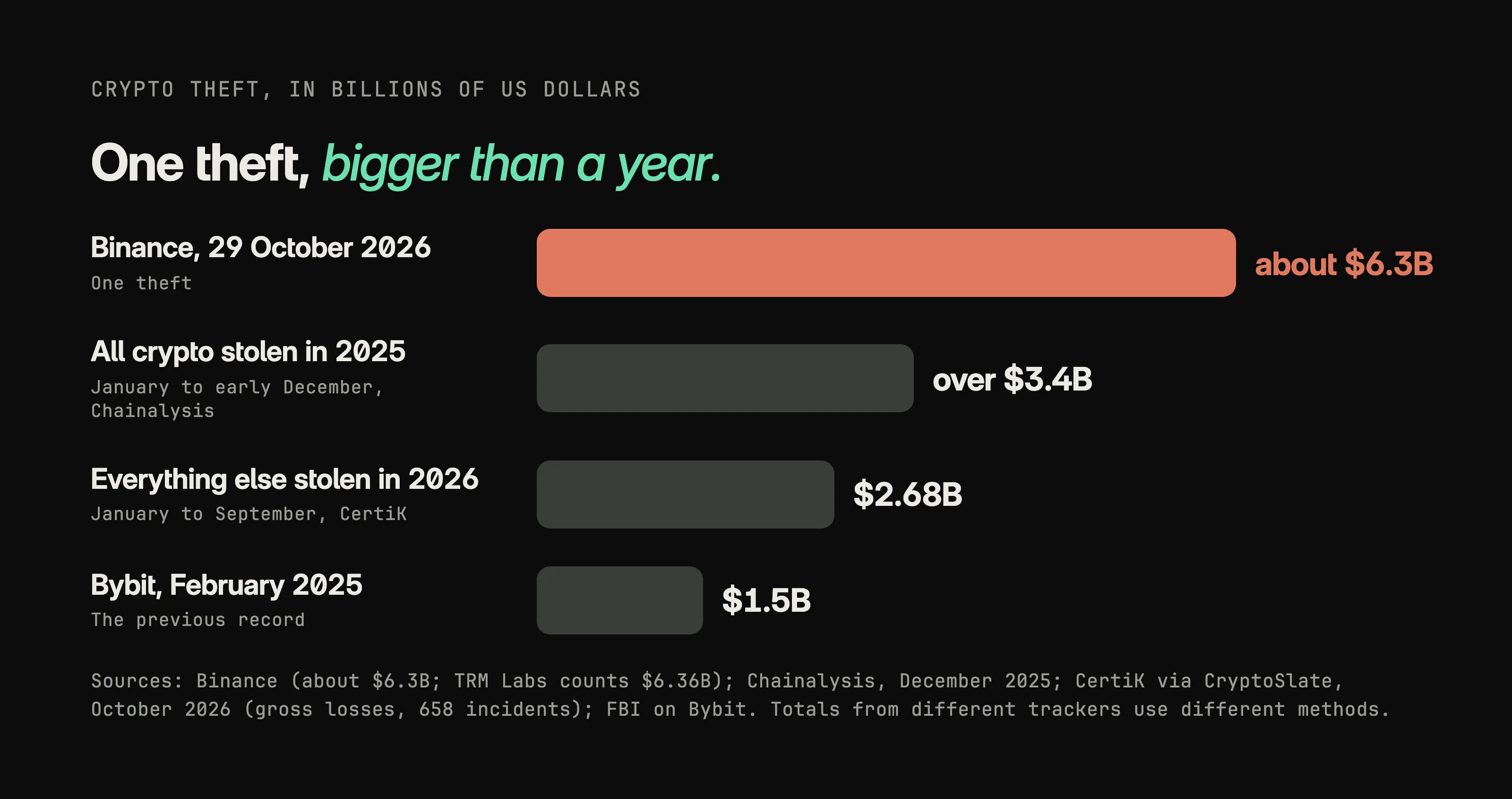
The Binance theft alone is larger than the $3.4 billion ↗ Chainalysis counted as stolen from January to early December 2025, and more than twice the $2.68 billion ↗  CertiK recorded for the first nine months of 2026. It also fits the shape of the year: the largest losses arrive through people's computers and the systems that sign transactions, far more than through bugs in code.
The 30‑second version
- →What happened: from about 20:05 UTC on 29 October, attackers moved roughly $6.3 billion out of
 Binance's hot wallets, the wallets an exchange keeps online to pay out withdrawals, across ten blockchains.
 TRM Labs counts $6.36 billion.
- →How, so far: Binance's first update said the incident may involve a compromised DevOps engineer's laptop that gave the attacker a service able to submit withdrawals. It found no evidence that private keys leaked, and has since found more points of breach.
- →The money: about $3 billion is frozen, most of it stablecoins frozen by
 Tether and
 Circle; TRM counts about $2.7 billion. Binance says it will cover every loss and has set aside more than $6.34 billion.
- →Who: TRM Labs and Chainalysis attribute the theft to TraderTraitor, a North Korean state hacking group, with high confidence;
 Elliptic says likely. Binance and the FBI have named no one.
- →The same week: Chainalysis said an outside actor used "offensive agentic techniques" to reach its internal systems, exposing customer names, emails and roles.
- →AI and Binance: no investigator has linked AI to the Binance theft so far.
Twenty minutes
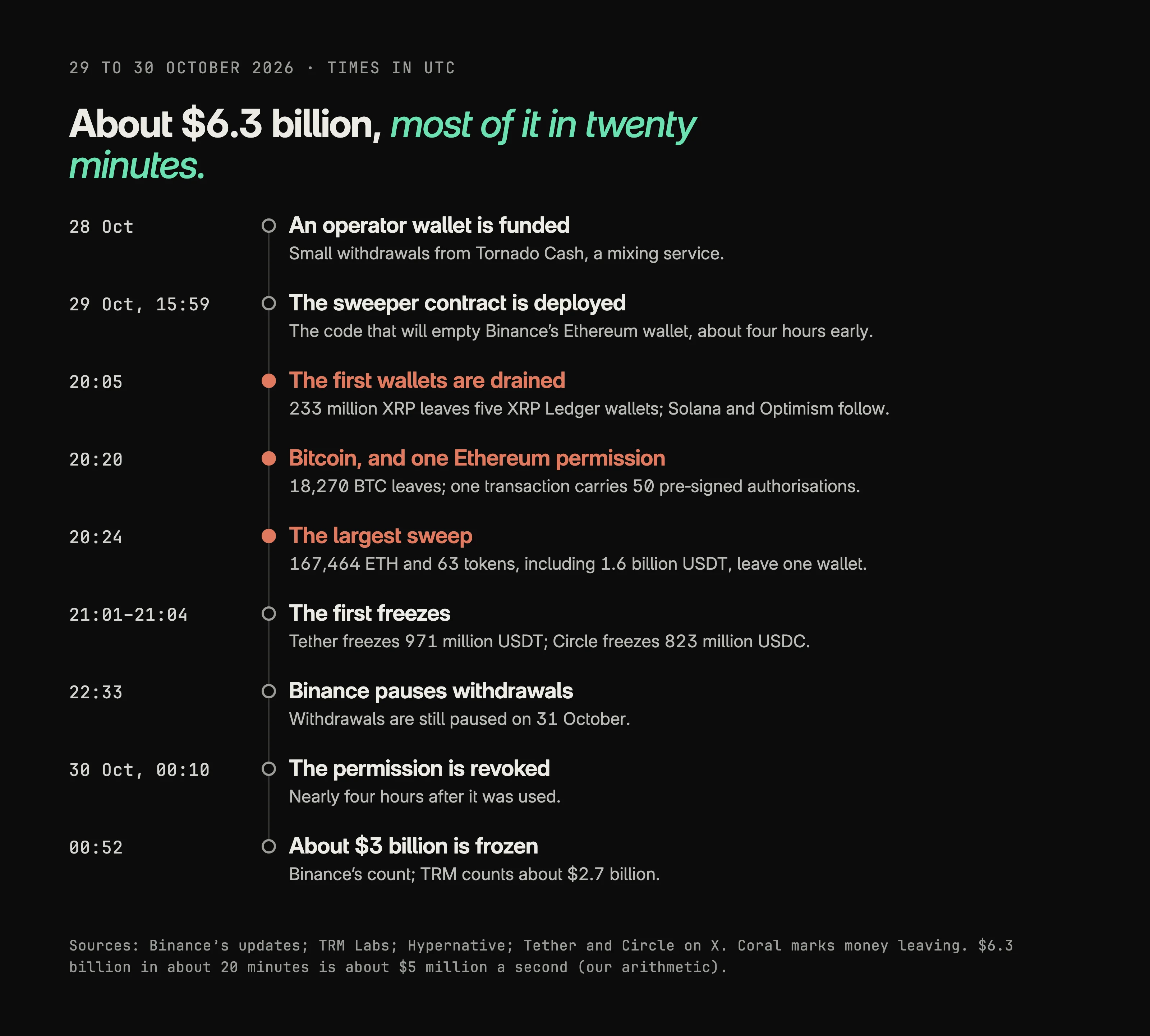
The preparation started a day earlier. On 28 October an operator wallet was funded with small withdrawals from Tornado Cash, a mixing service, and on 29 October the attack code was tested on two wallets and rehearsed on a third, according to TRM Labs ↗ and  Hypernative ↗. The contract that would empty Binance's main Ethereum wallet was deployed at 15:59 UTC, about four hours before it was used.
Then it moved quickly. From 20:05, five XRP Ledger wallets sent 233 million XRP, and Solana and Optimism wallets followed. At 20:20 the bitcoin hot wallet sent 18,270 BTC, and a single Ethereum transaction carried 50 pre-signed authorisations for one Binance wallet. At 20:24 that wallet sent 167,464 ETH and 63 tokens, including 1.6 billion USDT. On our arithmetic, $6.3 billion in about 20 minutes is about $5 million a second.
The response was quick too. Tether froze 971 million USDT at 21:01 and Circle 823 million USDC at 21:04, minutes after the coins reached the attacker, according to TRM's timeline; within the hour Tether's chief executive put its freeze ↗ at more than 1.5 billion USDT and Circle's at more than 800 million ↗ USDC. Binance paused withdrawals at 22:33, and by 00:52 on 30 October put the frozen total at about $3 billion. The Ethereum permission the attacker used was revoked at 00:10, nearly four hours after it was used, according to Hypernative. Bitcoin, ether and XRP cannot be frozen this way; on TRM's count about $2.4 billion stayed with the attacker.
From a laptop to ten blockchains
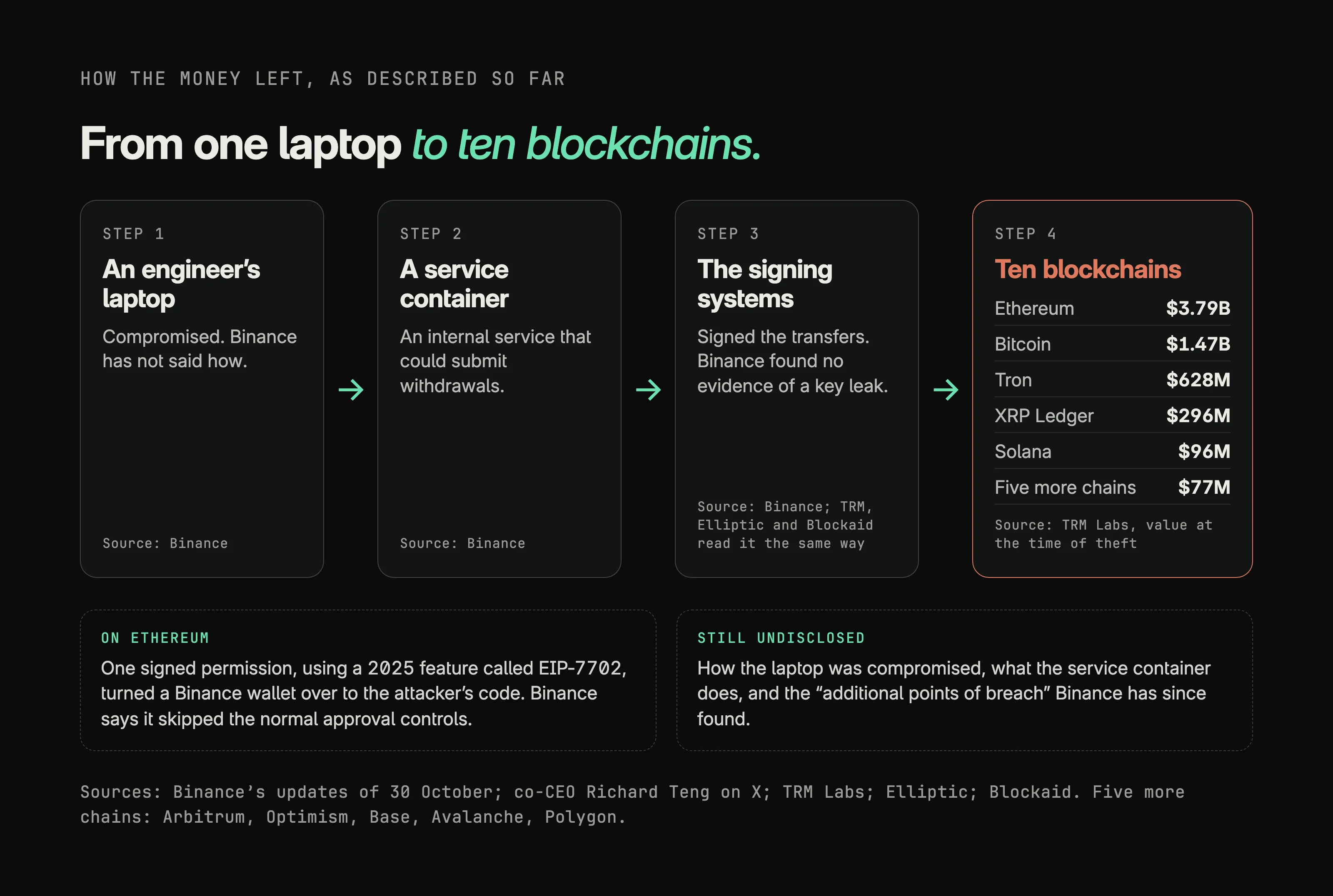
Binance's first update ↗, published at 02:23 on 30 October, said the incident "may involve a compromised DevOps engineer's laptop", which gave the attacker access to "a service container" used to submit unauthorised withdrawals. It said it had found "no evidence of any wallet private key leak". Its second update ↗, signed by co-CEOs Yi He and Richard Teng that evening, refers to "a compromised laptop" and to "additional points of breach" found since.
Teng said ↗ the attack went beyond one engineer's permissions and took many steps. He described a self-destruct mechanism that destroyed the attacker's tools and traces, and said the Ethereum permission was granted outside Binance's normal approval controls.
The analytics firms read the evidence the same way. TRM ↗ points to a compromise of Binance's hot-wallet signing infrastructure, the systems that approve and sign outgoing transactions, on all ten chains. Elliptic ↗ says the attacker appears to have got Binance's own systems to sign.  Blockaid ↗ counts eleven hot-wallet keys signing transfers and calls it misuse of a signing system. The keys stayed where they were; the systems that use them signed for the attacker. As
 Immunefi's Goncalo Magalhaes put it ↗, once signing software is compromised, "it doesn't really matter if the key itself is secure."
On Ethereum the attacker used EIP-7702, a feature added to Ethereum in May 2025 that lets an ordinary wallet hand control to a piece of code. One signed authorisation turned a Binance wallet into the attacker's sweeper, code that passes on whatever arrives. TRM found 50 authorisations signed in advance, so that one would match the wallet's transaction counter whenever the attack ran.
Binance has not said how the laptop was compromised, what the service container does, or what the other points of breach are. It has promised technical findings and a full post-mortem.
Who did it
TRM ↗ attributes the theft to TraderTraitor, North Korea's main crypto-theft unit, "with high confidence". Chainalysis ↗ reached the same view after watching stolen Binance funds mix, in real time, with funds from the $388 million  Bitget theft in September, and the investigator ZachXBT traced the same overlap ↗. Elliptic ↗ calls North Korea likely and adds caveats: the overlap is small, about $39,000 of Binance funds against about $510,000 from Bitget, and could mean a shared launderer, and the laundering has been slower than usual. The FBI ↗ says it is aware and engaged, and has named no one. Binance has named no one either.
TraderTraitor is the name US agencies use for a North Korean group that targets crypto companies. A 2022 joint advisory ↗ describes its method: messages to system administrators, developers and DevOps staff, often posing as recruiters, that deliver trojanised crypto applications. The FBI tied it to the  $1.5 billion Bybit theft ↗ of February 2025, which began on a compromised developer machine at Bybit's wallet provider,
 Safe{Wallet}, according to Safe ↗; and to the $308 million DMM Bitcoin theft ↗ of 2024, which began with a fake recruiter's pre-employment test.
The same week, AI agents inside Chainalysis
On 30 October Chainalysis said ↗ it had detected, earlier in the month, an external actor "using offensive agentic techniques" to gain unauthorised access to its systems and internal tools. Customer user IDs, full names, email addresses and organisation role labels were accessed. It found no indication of access to investigation content, query results, clear-text passwords, two-factor secrets or session tokens, and it asked customers to watch for unexpected password-reset requests and sign-in prompts.
Chainalysis says the incident "is not related" to the Binance theft, and describes it as part of an industry-wide rise in AI-driven attacks. It has not described the agents, the way in, or how many customers are affected. The two incidents are separate: one shows how far a single compromised machine can reach; the other shows attackers handing the work of breaking in to AI agents, at a company whose business is investigation. Chainalysis is now on the Record.
The 2026 pattern: the computer is the way in
Most crypto incidents this year were bugs in smart contracts, the code that runs on a blockchain. Most of the money went another way. TRM ↗ found that compromised keys, seed phrases and signing systems were about 15% of incidents in the first half of 2026 and about 76% of the losses;  Hacken ↗ put compromised keys, signers and infrastructure at 88% of second-quarter losses. The largest cases started with a person and their machine.
| Incident | Where it started | Lost |
|---|---|---|
| Binance, Oct 2026 | An engineer's laptop, then a service that could submit withdrawals (Binance ↗) | about $6.3B |
| Bitget, Sep 2026 | A zero-day in a third-party security product, then forged withdrawal commands (The Hacker News ↗) | about $388M |
 KelpDAO, Apr 2026 | A six-week breach of  LayerZero, which secured its bridge (The Defiant ↗) | about $292M |
 Drift, Apr 2026 | Six months of in-person deception of the people who approve transactions (Chainalysis ↗) | about $285M |
 Humanity Protocol, Jun 2026 | Malware on a developer machine that held backed-up keys (The Defiant ↗) | about $31–36M |
 Step Finance, Jan 2026 | Executives' devices (BleepingComputer ↗) | about $29–40M |
| Bybit, Feb 2025 | A compromised developer machine at its wallet provider (The Block ↗) | $1.5B |
The way in is often a job offer. A joint advisory ↗ from agencies in Japan, the US, Australia and Germany, reported by The Hacker News ↗, says North Korea's Contagious Interview campaign, fake job interviews whose coding tests install malware, has compromised at least 30,000 devices in more than 100 countries and taken at least $10.71 million from over 7,000 wallets.
October added smaller cases with the same shape:
- →
 Polymarket, 29 October: more than $2.5 million through what it called a compromised third-party provider; affected traders will be reimbursed (The Block ↗).
- →
 CoinDCX, confirmed 25 October: about $16 million from wallets retired after a 2025 hack, where funds had built up after an automated sweep failed (The Block ↗).
- →79thVault, 7 October: about $12.5 million through a privileged function held by one operator role, with no multisig and no time lock; whether a key leaked or an insider acted is still open (Forklog ↗).
- →
 Qubic, 18 October: about $1.4 million from 1,404 wallets whose seed phrases its wallet tool generated weakly (Cointelegraph ↗).
Where AI fits
No investigator has linked AI to the Binance theft. Binance, TRM, Chainalysis and Elliptic describe the attack without mentioning it, and Immunefi's head of security, Goncalo Magalhaes, told The National ↗ there was no sign AI was used. Claims that AI ran the attack, made on social media and in at least one broadcast segment, rest on no published evidence.
AI does run through the rest of the year's record:
- →Chainalysis: attackers used AI agents to break in, on the company's own account (Chainalysis ↗).
- →North Korea: groups linked to North Korea used Google's Gemini to research crypto wallets, write lures and try to write theft code; Google disabled the accounts (Google Threat Intelligence ↗, November 2025).
- →Agents on autopilot:
 CloudSEK found a criminal operator running AI coding agents, including Claude Code and Codex, in full-auto mode with safety approvals switched off, against crypto and DeFi targets; it counted roughly 34 confirmed breaches in July 2026 (CloudSEK ↗, August 2026).
- →In tests: in Anthropic's May 2026 update of its smart-contract benchmark, Claude Mythos Preview took $35 million in simulated exploits, and for Anthropic's models since Opus 4.5 exploit revenue was doubling about every 0.7 months (Anthropic ↗). No 2026 theft has yet been confirmed as found or built by AI.
Numbers and claims to stop repeating
- →"AI did it." No investigator has said so.
- →"$718 million was stolen in October." That is Chainalysis's figure for October 2022 ↗, circulating as if it described 2026.
- →"$2 billion was stolen." An early estimate from on-chain watchers; Binance's own figure is about $6.3 billion.
- →"Binance's private keys were stolen." Binance says it found no evidence of a key leak; the analytics firms describe its own signing systems being made to sign.
- →"The FBI has blamed North Korea." The attribution so far comes from TRM, Chainalysis and Elliptic; the FBI says it is engaged.
What to check this week
Binance runs one of the most heavily defended systems in crypto. The questions below apply to any team with a service that can move money, data or code without a person approving each step: a hot wallet, a payments API, a deployment pipeline.
- →Which machines can reach the service that moves money? List them. A developer laptop that can reach it is part of it. Keep signing and payout services reachable only from dedicated, locked-down machines.
- →Does every signature pass the same approval path? Binance says the Ethereum permission bypassed its normal controls. Have the signing service refuse any transaction type outside an approved list, including newer ones such as EIP-7702 delegations.
- →How much can leave, and how fast? Set outflow limits per wallet and per minute that pause payouts automatically, and keep hot wallets holding only what payouts need.
- →Where do interview tests and unknown code run? Coding tests, take-home projects and cloned repositories belong in a disposable environment, far from work credentials.
- →Which retired systems still hold value? Empty and switch off anything retired, then check it stays empty.
- →Can one key or one person move funds alone? Require more than one approver and a delay for privileged changes.
- →Who calls the stablecoin issuers? Tether and Circle froze about $2.4 billion within roughly an hour. Know the contacts, and rehearse the call.
- →What can AI agents on developers' machines reach? Coding agents run commands with the developer's access. Limit what they can run and which credentials they can see.
Rules that hold or break
Each of those checks can be written as a rule: a developer laptop has no route to the withdrawal signer; a hot wallet signs only approved transaction types; outflow above the limit pauses withdrawals. Written down, a rule can be re-proven on every release, holding or broken. That is the practice ExploitOps describes; the rules page shows how rules are written, and our piece on three side doors covers what to ask each vendor.
What is still unknown
- →How the laptop was compromised, and when the attacker first got in.
- →What the service container is, and what the additional points of breach are.
- →How valid signatures were produced on ten chains with no key leaked.
- →Whether the link to Bitget means the same attacker or a shared launderer.
- →Whether the frozen funds return to Binance, and how.
- →How the attackers reached Chainalysis's systems, and how many customers are affected.
We will update this piece when Binance publishes its technical findings and post-mortem.
Sources
- →Binance, Security Incident Update ↗ and Security Incident Update #2 ↗, 30 October 2026; Richard Teng, on X ↗, 30 October 2026
- →TRM Labs, North Korea steals USD 6.36 billion from Binance ↗, 29–30 October 2026
- →Chainalysis, Binance hack: tracing the $6.4 billion theft ↗ and Security incident information ↗, 30 October 2026
- →Elliptic, Binance: the largest hack in history ↗, 30 October 2026
- →Hypernative, Inside the largest crypto theft of all time ↗, 30 October 2026; Blockaid, detection write-up ↗, 29 October 2026
- →Tether's Paolo Ardoino ↗ and Circle's Jeremy Allaire ↗ on X, 29 October 2026; ZachXBT on X ↗, 30 October 2026
- →Nextgov/FCW, FBI involved in response to Binance hack ↗, 30 October 2026
- →Chainalysis, 2025 crypto theft ↗, 18 December 2025; CertiK via CryptoSlate ↗, 2 October 2026; TRM Labs, H1 2026 hacks ↗; Hacken, Q2 2026 report ↗
- →CISA, FBI and Treasury, TraderTraitor advisory AA22-108A ↗, April 2022; FBI, Bybit attribution ↗, February 2025; BleepingComputer, DMM Bitcoin ↗, December 2024
- →Joint advisory on Contagious Interview, IC3 ↗, September 2026, via The Hacker News ↗
- →Google Threat Intelligence, Threat actor usage of AI tools ↗, November 2025; CloudSEK, AI-agent-driven offensive operation ↗, August 2026; Anthropic, exploit evaluations ↗, May 2026
- →The National, analysts on AI and the Binance hack ↗, 30 October 2026
The logos are each company's own published versions. They identify the companies named in their public statements; MATT has no affiliation with Binance or Chainalysis.
Questions
How much was stolen from Binance?
Binance puts the total at about $6.3 billion, taken from its hot wallets on 29 October 2026 across ten blockchains; TRM Labs counts $6.36 billion and Elliptic $6.43 billion. About $3 billion has been frozen, most of it stablecoins frozen by Tether and Circle. It is the largest theft in crypto history, about four times the $1.5 billion Bybit theft of 2025.
How did the Binance hack happen?
Binance says its first findings point to a compromised engineer's laptop that gave the attacker access to a service able to submit withdrawals, and it has since found additional points of breach. It found no evidence that private keys leaked; analysts say Binance's own signing systems were made to sign the transfers. Binance has promised technical findings and a full post-mortem.
Who was behind the Binance hack?
TRM Labs and Chainalysis attribute it with high confidence to TraderTraitor, a North Korean state hacking group, citing links to the Bitget theft of September 2026. Elliptic calls North Korea likely, with caveats. The FBI says it is engaged and has made no attribution, and Binance has named no one.
Was AI used in the Binance hack?
No investigator has said so. Binance, TRM Labs, Chainalysis and Elliptic describe the attack without mentioning AI. Separately, Chainalysis disclosed that attackers using AI agents breached its own systems the same month, an incident it says is unrelated to Binance.
What happened at Chainalysis?
On 30 October 2026 Chainalysis said it had detected an external actor using offensive agentic techniques to gain unauthorised access to its systems and internal tools. Customer user IDs, names, email addresses and role labels were accessed; it found no indication that investigation content, passwords, two-factor secrets or session tokens were reached.
What is EIP‑7702?
A feature added to Ethereum in May 2025 that lets an ordinary wallet hand control to a piece of code. In the Binance theft, one signed EIP-7702 authorisation turned a Binance wallet into the attacker's sweeper; Binance says that permission was granted outside its normal approval controls.
What should a company check after the Binance hack?
Which machines can reach the service that moves money; whether every signature passes the same approval path; how much can leave and how fast; where interview tests and unknown code run; which retired systems still hold value; whether one key or person can move funds alone; who calls the stablecoin issuers; and what AI agents on developers' machines can reach.